The context
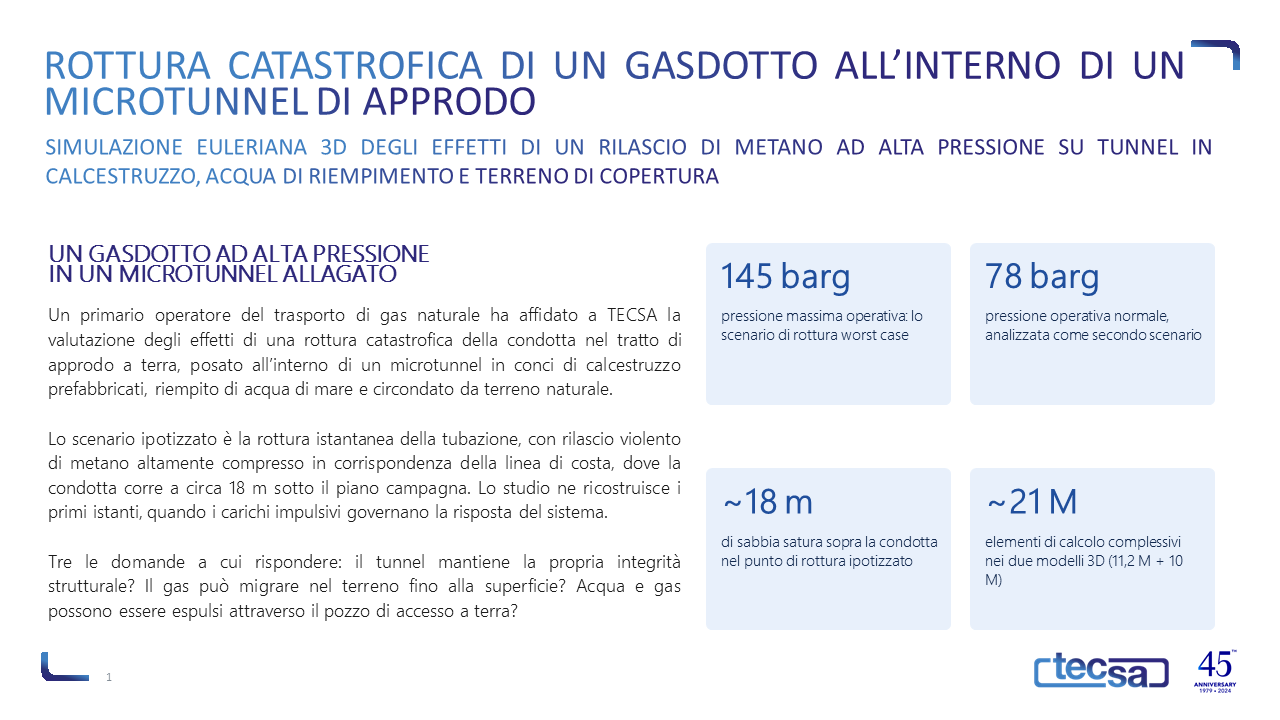
A leading natural gas transmission operator commissioned TECSA to assess the effects of a catastrophic rupture of the pipeline in the onshore section, laid within a microtunnel constructed from prefabricated concrete segments, filled with seawater and surrounded by saturated sandy soil. The aim was to answer three questions: does the tunnel maintain its structural integrity? Can the gas migrate through the ground to the surface? Can water and gas be expelled through the onshore access shaft?
The approach
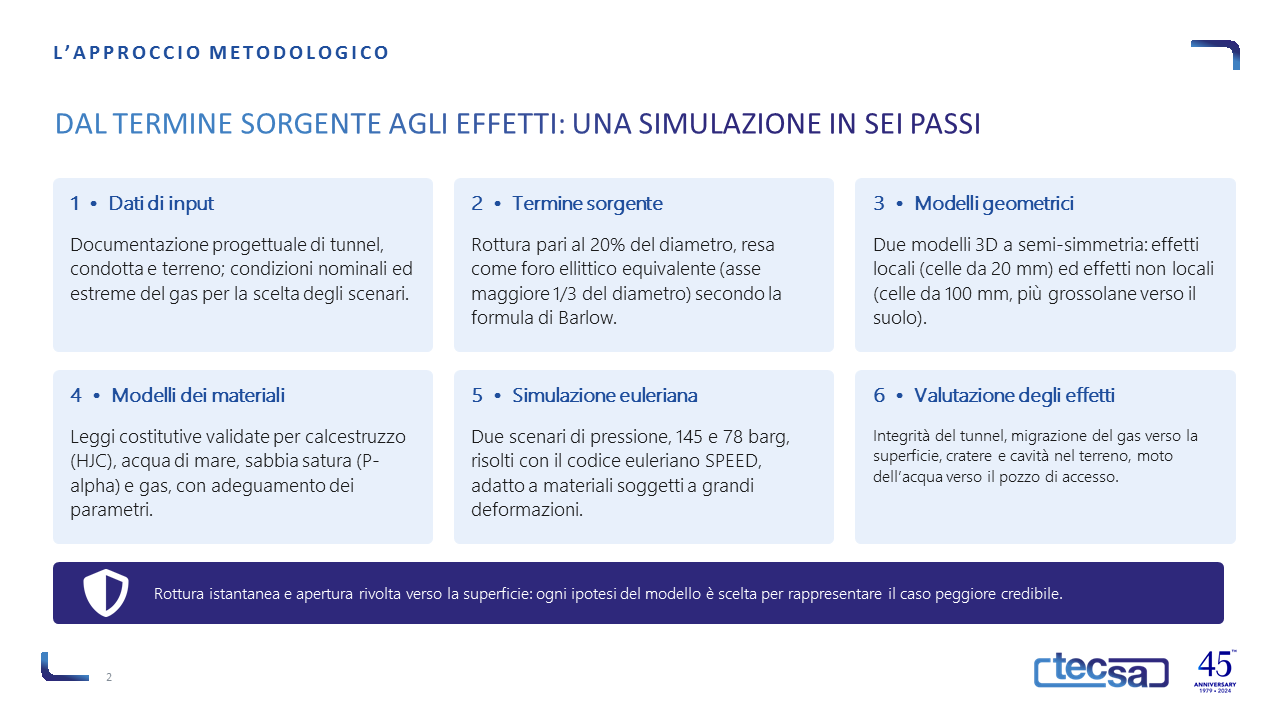
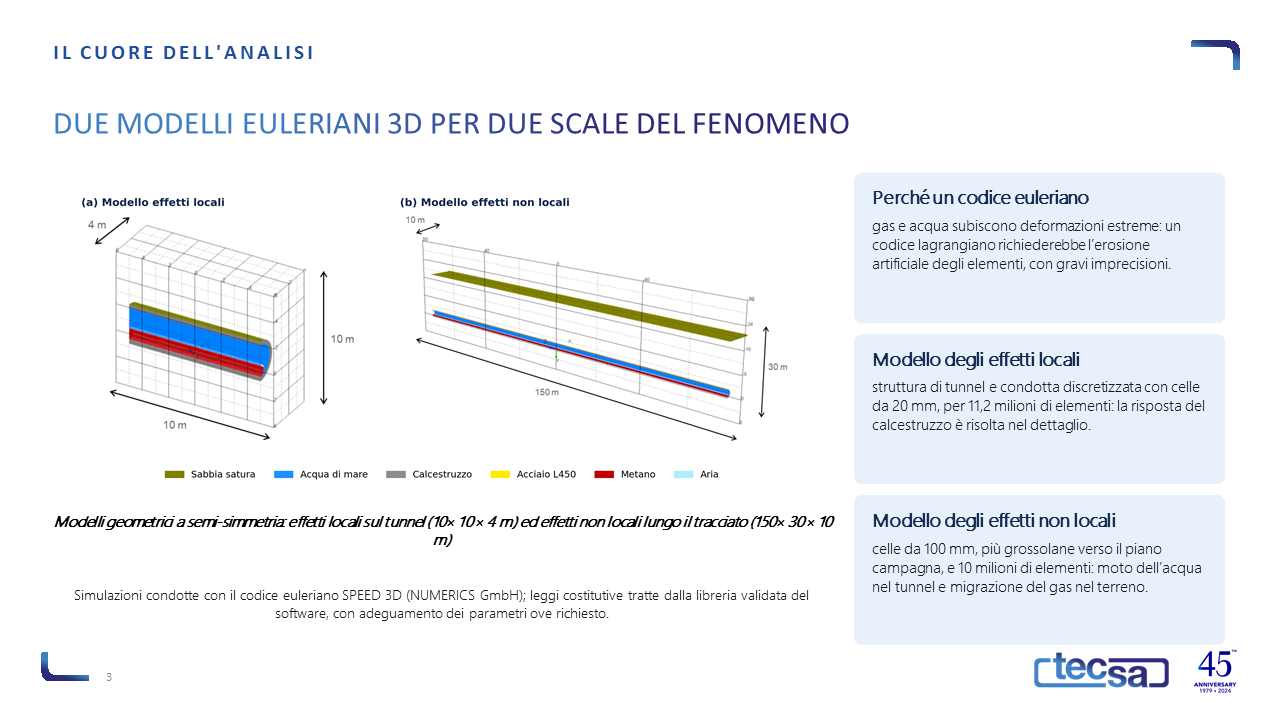
The rupture, equal to 20 per cent of the pipeline’s diameter, was modelled as an equivalent elliptical hole based on Barlow’s formula, assumed to be instantaneous and facing the surface to represent the credible worst-case scenario. The simulations were carried out using the Eulerian code SPEED 3D, chosen because gas and water undergo extreme deformations that a Lagrangian code would only be able to resolve through artificial element erosion.
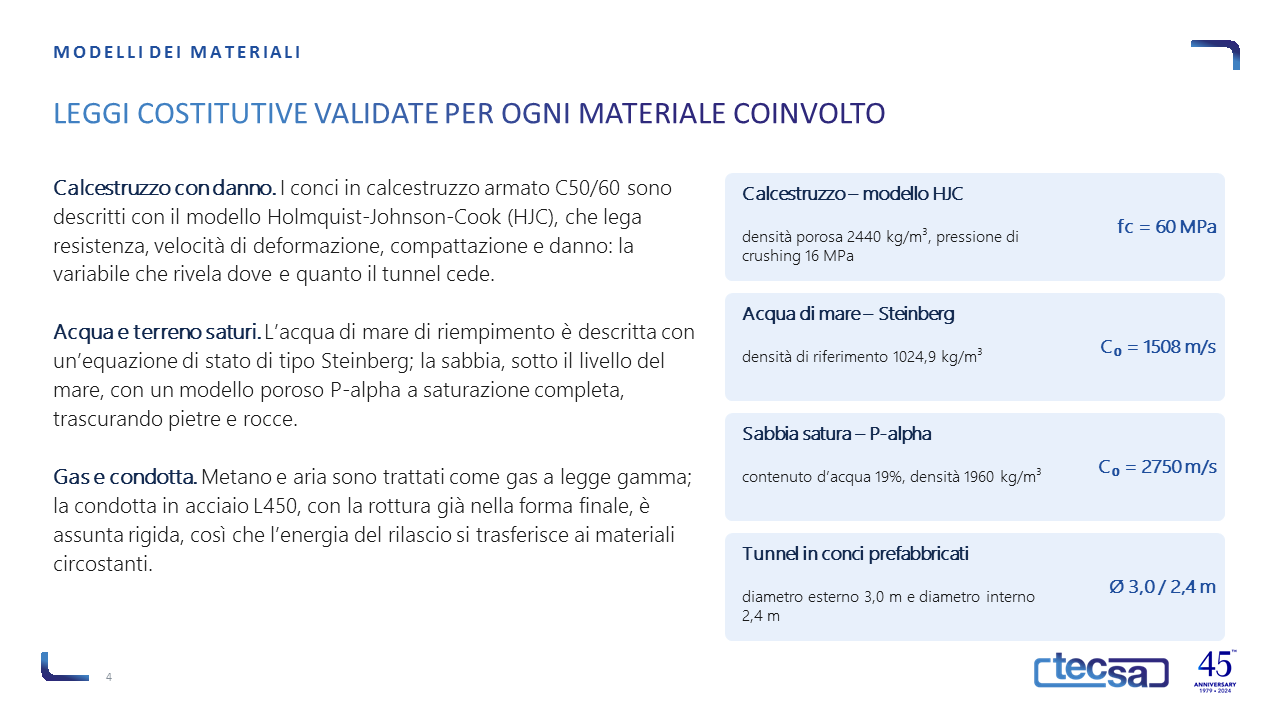
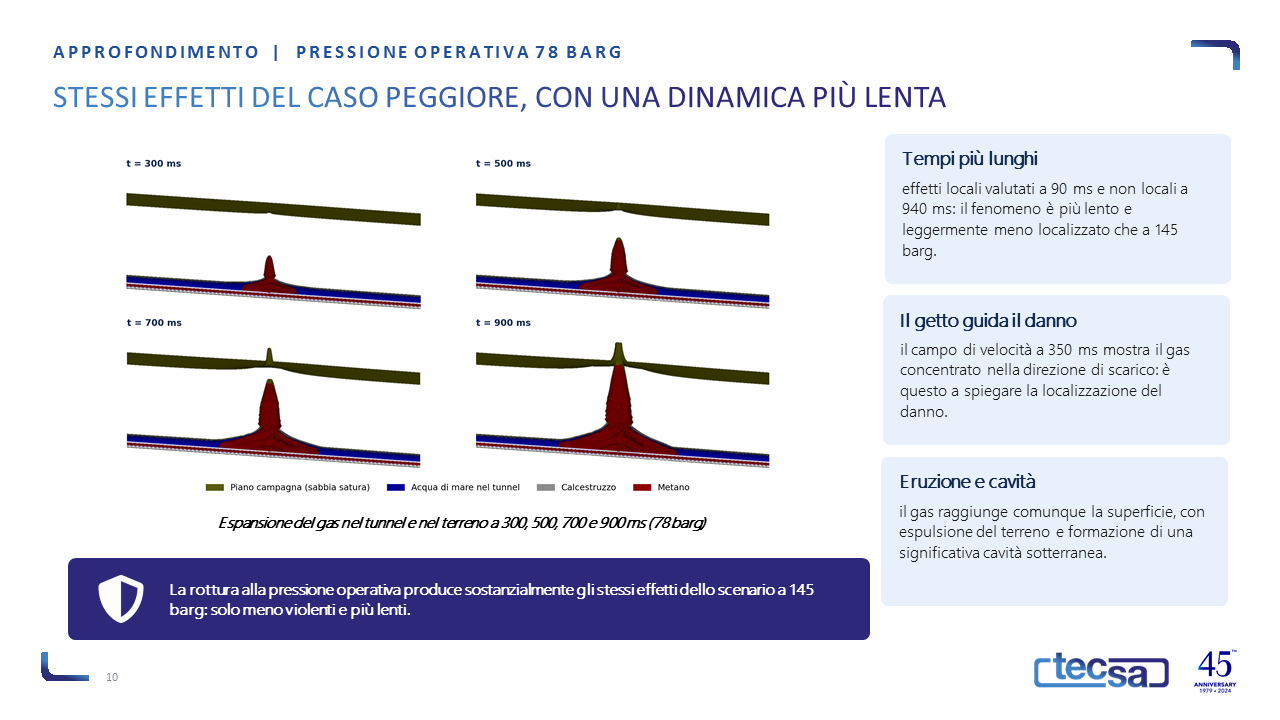
Two semi-symmetric 3D models were developed: one for local effects on the tunnel, with 20 mm cells and 11.2 million elements, and one for non-local effects in the tunnel and the ground, with 100 mm cells and 10 million elements. C50/60 concrete is modelled using the Holmquist-Johnson-Cook damage model, seawater using a Steinberg-type equation of state, and saturated sand using a P-alpha porous model. Two scenarios were analysed: the maximum operating pressure of 145 barg and the normal operating pressure of 78 barg.
The results
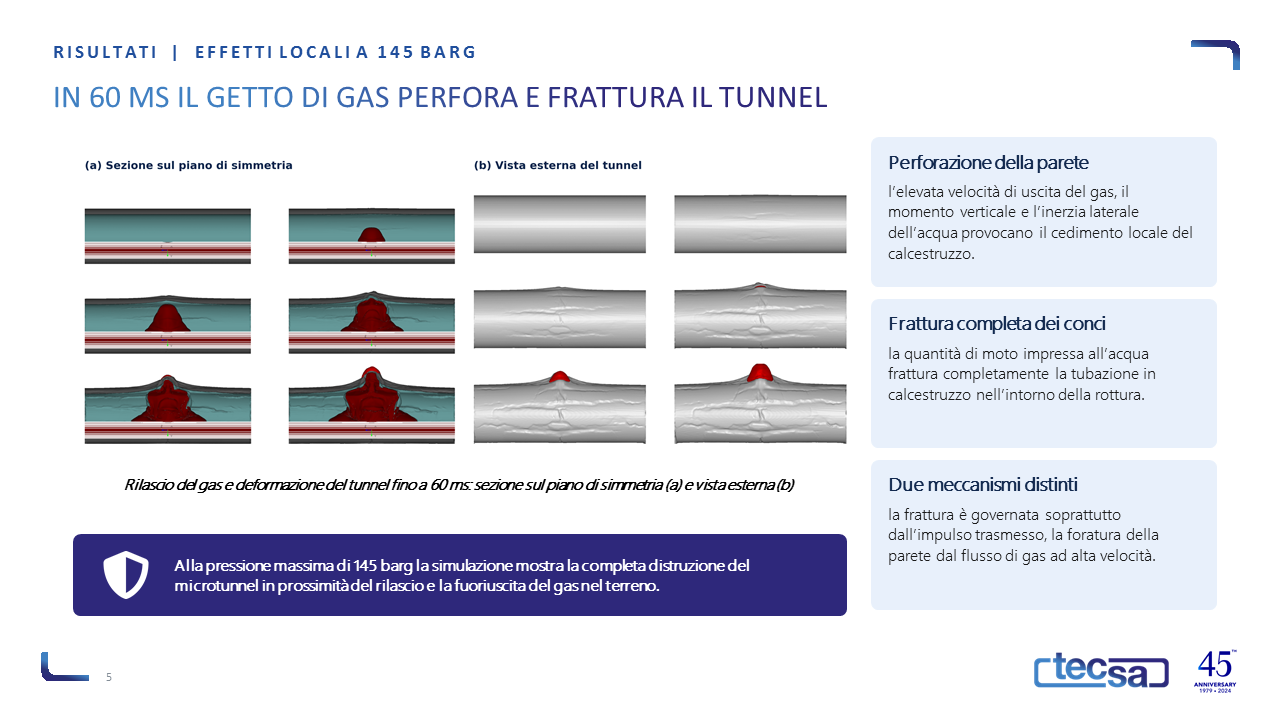
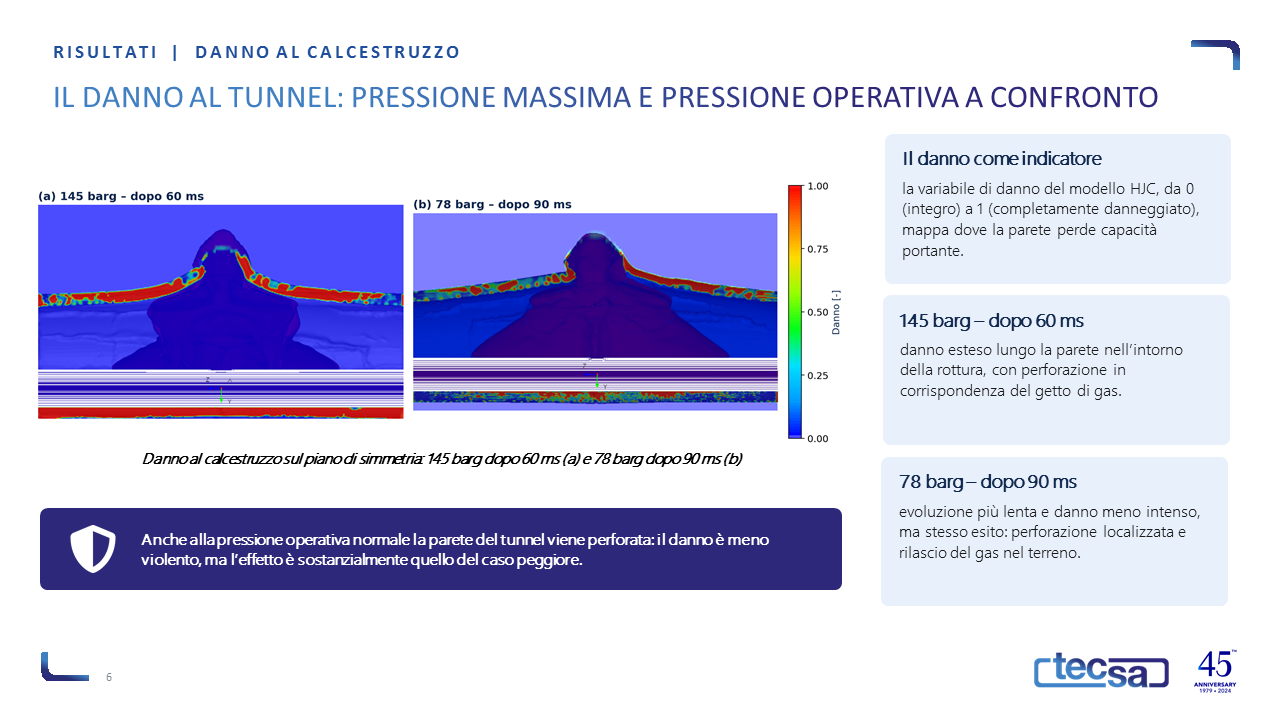
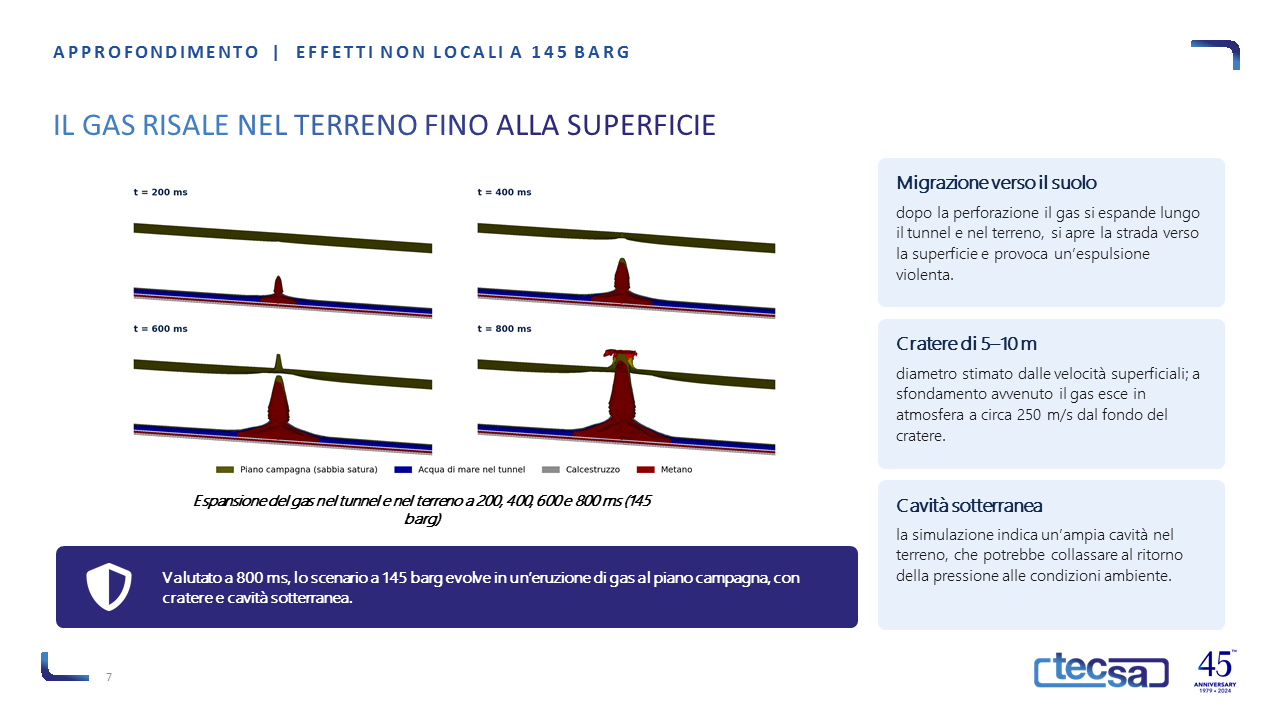
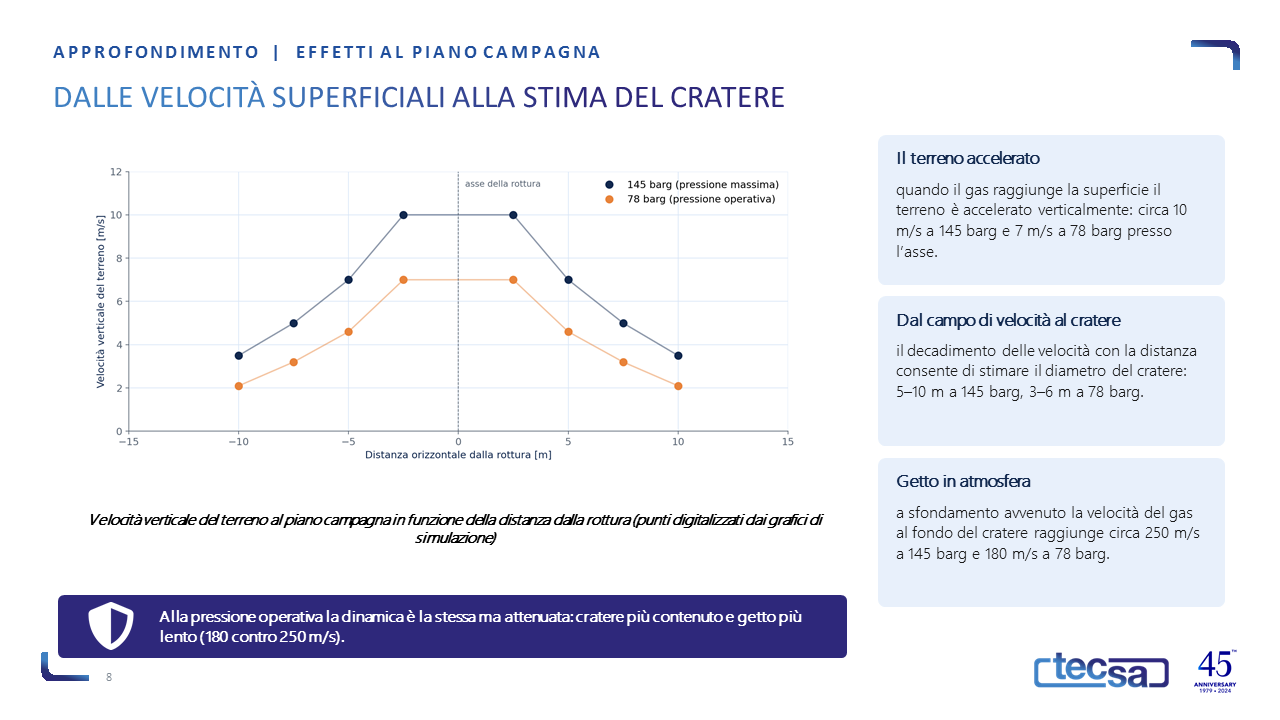
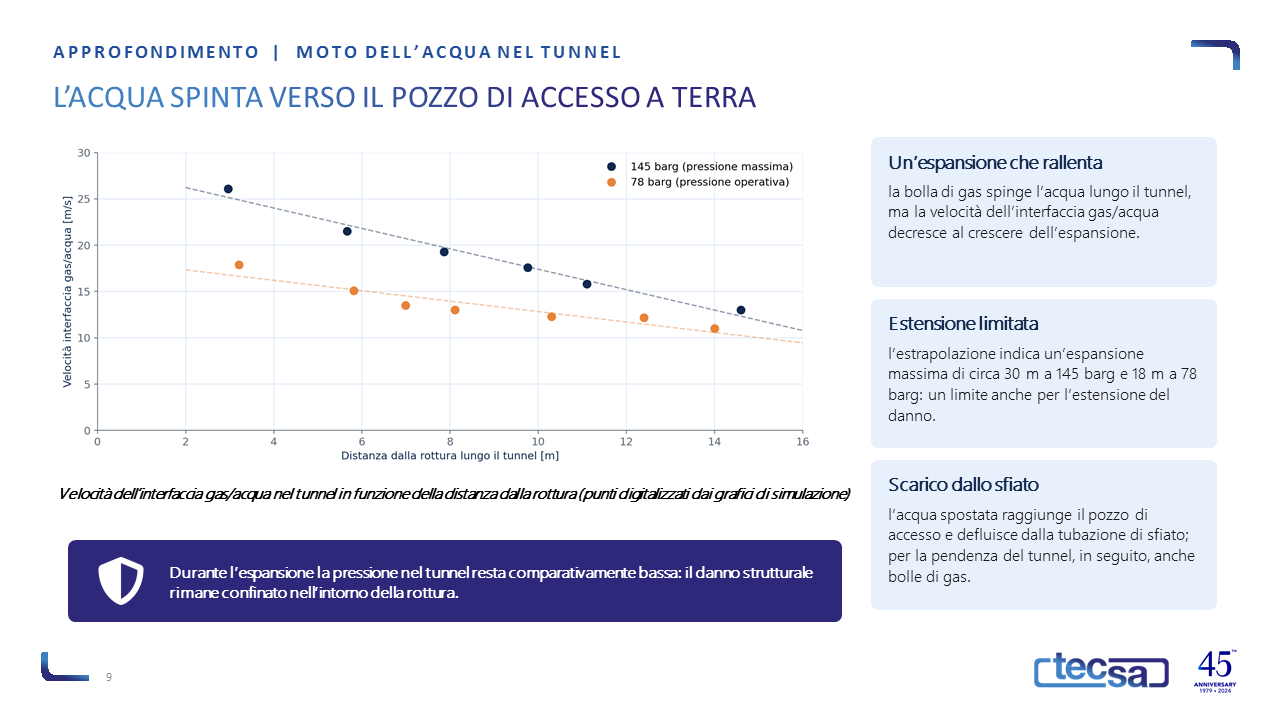
In both scenarios, the gas jet and the accelerated water penetrate the wall and fracture the segments near the point of failure; however, the damage remains localised, as the pressure inside the tunnel is comparatively low during expansion. The gas migrates through the ground to the surface, with an estimated crater diameter of 5–10 m at 145 barg and 3–6 m at 78 barg, and outflow velocities of approximately 250 and 180 m/s; the simulation also indicates the formation of an underground cavity that could collapse. Water is forced towards the access well and discharged via the vent pipe. At operating pressure, the effects are essentially the same, only less violent and slower.
Why TECSA
The study demonstrates TECSA’s ability to address accident scenarios that are not captured by simplified models, by combining a rigorous definition of the source term, advanced computational codes and validated constitutive laws within a documented and traceable framework of effects.