The context
An operator engaged in the storage and processing of explosive material commissioned TECSA to quantify the frequencies and the consequences of an accidental detonation at its site: fifteen storage magazines and two processing buildings, holding TNT, RDX, Composition B, plastic explosives, propellants and precursors in the maximum quantities permitted under the Italian TULPS regulations. Establishments that store and handle explosives account for around 6% of EU/EEA Seveso sites and show a steady accident record, with escalation from fire to mass detonation so rapid that active control measures are rendered ineffective. The distinctive challenge of the assignment lies in the limits of the prescriptive approach: quantity-distance safety distances assume free-field conditions and describe neither the reflections and channelling produced by the actual site geometry, nor the damage vectors other than overpressure.
The approach
The work began with the characterisation of the source term: conversion of the stored quantities into TNT-equivalent mass on the basis of the specific heats of detonation, with a factor of 0.70 for the energy absorbed by the rupture of the structure and the formation of the crater and a further 0.60 for munitions in metallic casings, ranging from 124 to 4,146 kg depending on the magazine. The frequency assessment called for two distinct strategies: for the magazines, a historical analysis of the external initiating events — direct lightning strike and fire at the perimeter — combined with the probabilities of failure on demand of the barriers, yielding 10⁻⁷ occasions/year for each individual magazine; for the processing buildings, where human involvement is continuous, a human reliability analysis using the SHERPA method, from hierarchical task analysis to the taxonomy of errors and the performance influencing factors, through to the error probabilities for each individual phase: 5.2·10⁻⁶ occ./year for propellant packaging and 7.94·10⁻⁵ occ./year for the assembly area of the melt-cast loading facility, the highest frequency of the entire site.
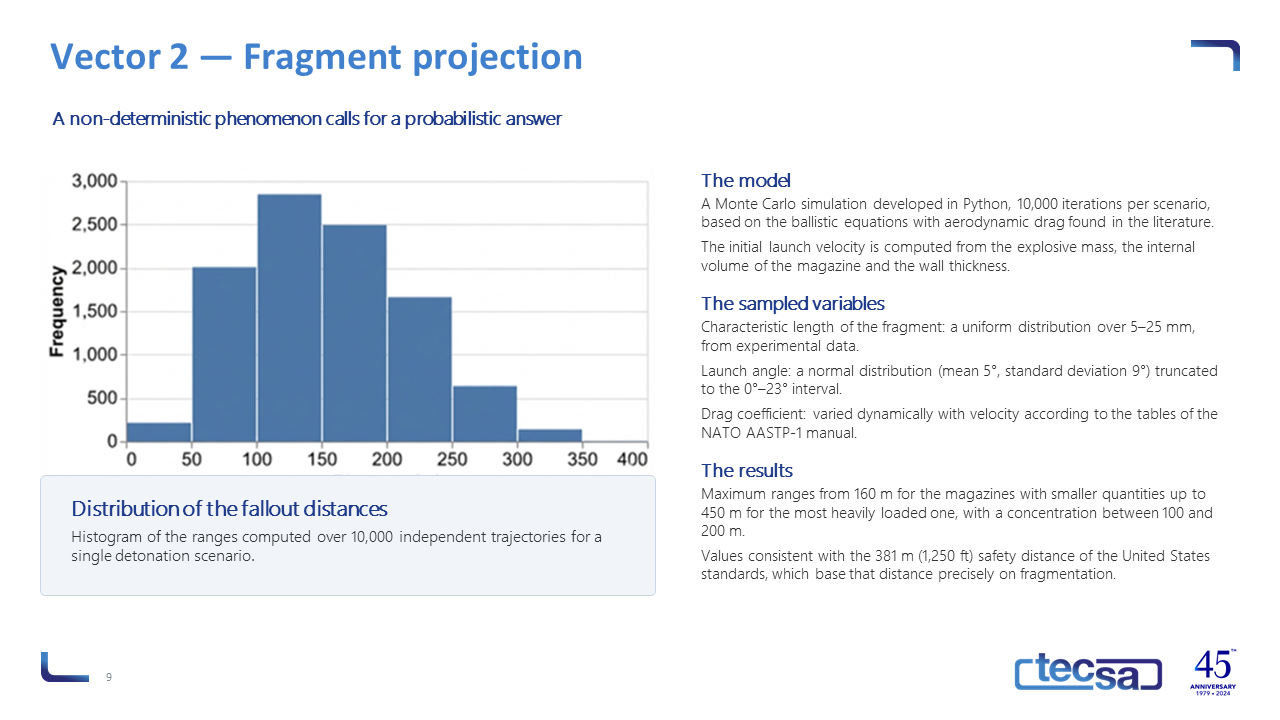
The consequences were calculated for three damage vectors, each with the most appropriate tool. Overpressure with the CFD code Viper::Blast, a multi-material solver with the Jones-Wilkins-Lee equation of state and a remapping chain over three nested domains, from a 0.1 m mesh in the near field to 1 m in the far field, extended until the 0.03 bar threshold was contained. Fragment projection with a Monte Carlo simulation developed in Python, 10,000 iterations per scenario, sampling the characteristic length of the fragment (5–25 mm), the launch angle and the drag coefficient from the tables of the NATO AASTP-1 manual. The dispersion of the toxic decomposition products with the FDS code in a “post-blast” approach, with the cloud introduced at a representative temperature of 1,273 K and the IDLH and LC₅₀ thresholds rescaled to a ten-minute exposure and assessed by probit analysis. The same chain was used to reproduce a sequence of quasi-simultaneous detonations between adjacent magazines, each charge being triggered at the arrival time of the preceding front as read from the computed flow field.
The results
The five overpressure thresholds of Italian Ministerial Decree 09/05/2001 place the reversible injury threshold between 102 and 330 m depending on the magazine, with asymmetrical footprints: magazines protected by earth barricades show an energy attenuation of 72–80%, consistent with the approximately 75% implicit in the reductions prescribed by NATO standards for earth-covered magazines, whereas the processing buildings, which have no barriers, behave as an unobstructed surface burst. The comparison with the free-field empirical relations agrees at the higher thresholds — 67, 100 and 158 m against 68, 96 and 153 m for a representative magazine — and diverges at the lowest, where CFD gives 212 m against 544 m. Fragment projection remains the dominant vector at long range, with distances of up to 450 m, consistent with the 381 m (1,250 ft) of the United States standards, which base that distance precisely on fragmentation; the toxic impact beyond the site boundary proves negligible, owing to the strong thermal buoyancy that lifts the cloud already in the near field. The quasi-simultaneous sequence widens the hazard footprint by a factor of 1.20–1.74 with respect to the most severe of the individual events: assessing the magazines one at a time underestimates its extent.
Why TECSA
TECSA supports operators in the quantitative assessment of major accident hazards with advanced numerical modelling tools: from the characterisation of the source term to the estimation of frequencies, the human factor included, through to the calculation of consequences across every relevant damage vector. A single point of contact from risk analysis to the preparation of the Safety Report, with validated calculation codes and methodologies submitted to the international scientific community.