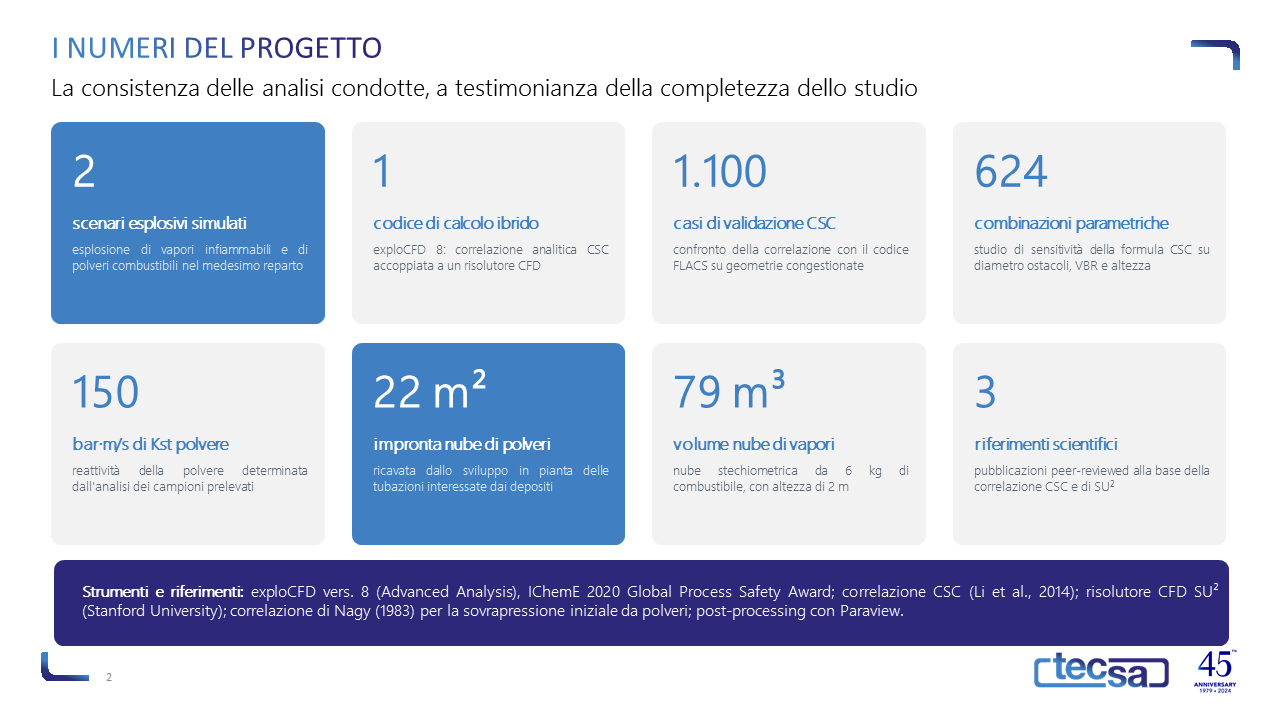
Following an explosion at a production unit within a chemical processing plant, TECSA was commissioned to carry out an analytical assessment of the consequences of two distinct accident scenarios: the explosion of a cloud of flammable aliphatic hydrocarbon vapours and the explosion of combustible dust accumulated inside process pipework, the presence of which had been documented on dismantled lines at the same plant. The aim of the study was to quantify, for each scenario, the evolution over time and space of the expected overpressures and to compare this with the reference damage thresholds (20–50 kPa), in order to support the physically-based discrimination between the accident scenarios.
Both scenarios were assessed using the same advanced computational code, exploCFD (version 8, Advanced Analysis, winner of the IChemE 2020 Global Process Safety Award), a hybrid model that analytically defines the initial overpressure conditions at ignition — using the CSC (Confinement Specific Correlation) for flammable vapours, validated on 1,100 cases simulated with FLACS in realistic congested geometries, and using the Nagy (1983) correlation for dusts — and calculates their spatio-temporal evolution using the open-source CFD solver SU² developed by Stanford University. For the vapour scenario, a parametric study of 624 combinations of obstacle diameter, Volume Blockage Ratio and cloud height identified the conditions necessary to reach the damage thresholds; the actual cloud was then simulated (6 kg of fuel at stoichiometric concentration, 79 m³, mesh with 20×20 cm cells, duration of 1 s with a time step of 1 ms) using congestion and confinement parameters consistent with the actual layout of the compartment. For the dust scenario, a cloud with a plan area of 22 m² was considered, derived from the pipe layout, with a Kst of 150 bar·m/s determined by laboratory analysis of the samples. The modelling is based on peer-reviewed scientific references (Li, Abdel-Jawad, Ma, *Journal of Loss Prevention in the Process Industries* 31, 2014; Abdel-Jawad et al., NAFEMS 2019; Palacios et al., AIAA 2013-0287).
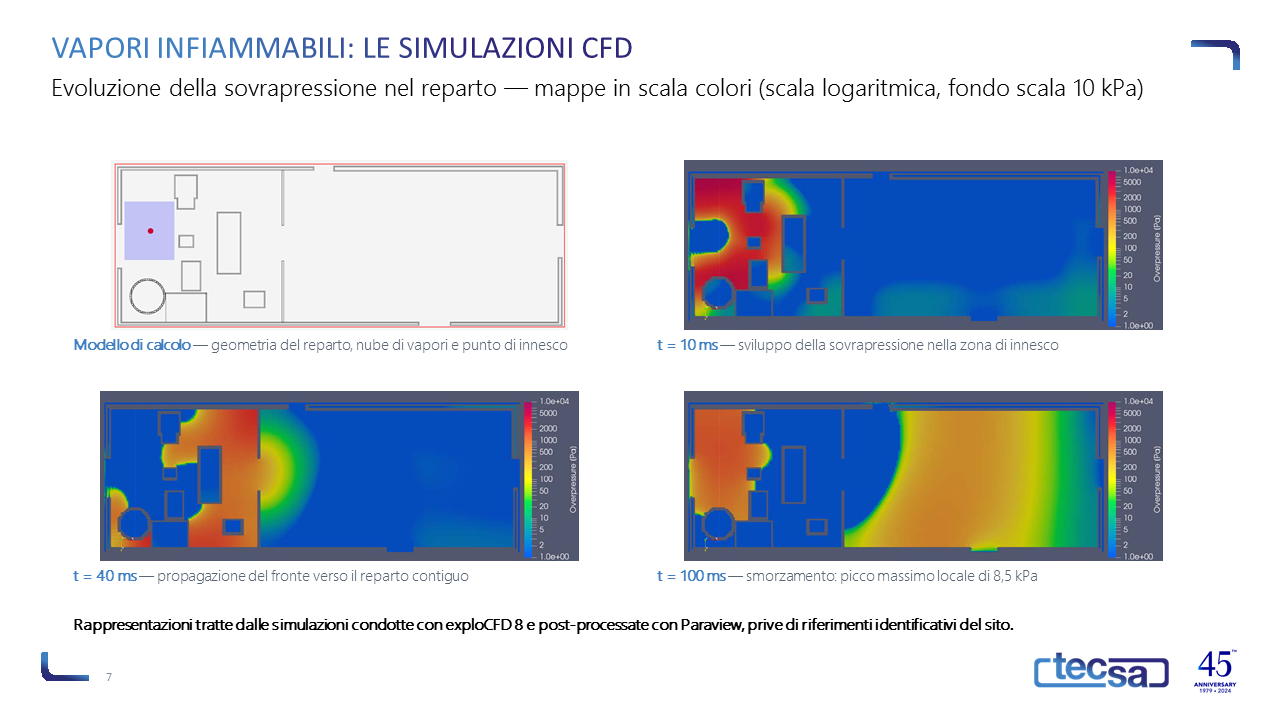
The analyses demonstrated that the vapour explosion scenario is not capable of generating overpressures consistent with the reference damage thresholds: screening using the CSC correlation showed that 115 kg of fuel would be required to reach 20 kPa (a cloud 4.9 m high extending across the entire department) and as much as 250 kg to reach 50 kPa (a cloud 10.6 m high, exceeding the height of the building), whilst the CFD simulation of the actual cloud yielded a localised maximum peak of 8.5 kPa, with overpressures not exceeding 1 kPa in the adjacent compartment. The combustible dust explosion, by contrast, reaches a peak of approximately 750 kPa (7.5 bar) at 27 ms, with an average wall overpressure exceeding 3 bar, consistent with extensive damage. The use of the same sophisticated calculation code for scenarios of different types ensures methodological consistency and comparability of results, and allows for a detailed study of the physical effects potentially associated with a wide range of accident scenarios, in accordance with the structured analysis and reporting methodology adopted by TECSA.