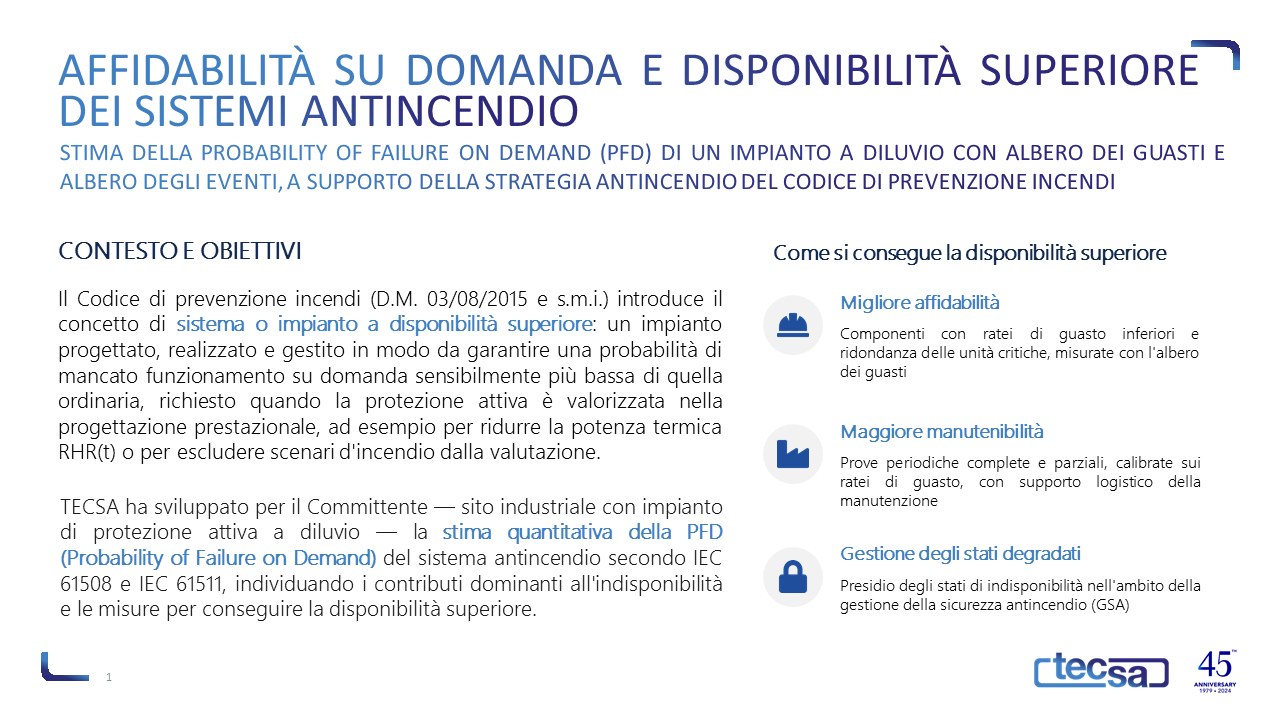
The Fire Prevention Code (Ministerial Decree of 3 August 2015, as amended) introduces the concept of a system or installation with superior availability: an active protection system designed, constructed and managed in such a way as to ensure a probability of failure on demand that is significantly lower than the standard probability. Higher availability is required, in particular, when active protection is utilised in performance-based design — for example, to reduce the thermal power released by the fire (RHR(t)) or to exclude certain fire scenarios from the assessment — and is achieved by combining improved reliability (components with lower failure rates, redundancy of critical units), greater maintainability (periodic full and partial tests with adequate logistical support) and the management of degraded states within the framework of fire safety management (GSA). As the qualification must be measured quantitatively, it is necessary to estimate the system’s on-demand reliability, expressed as the Probability of Failure on Demand (PFD).
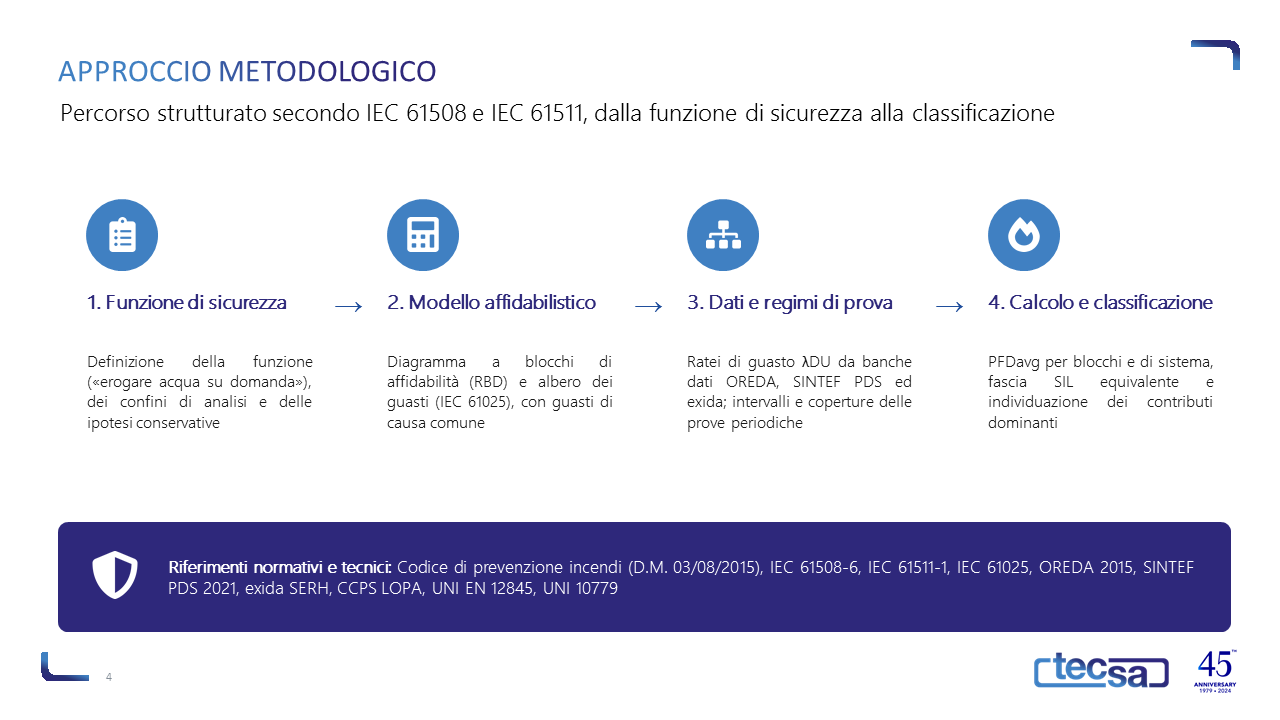
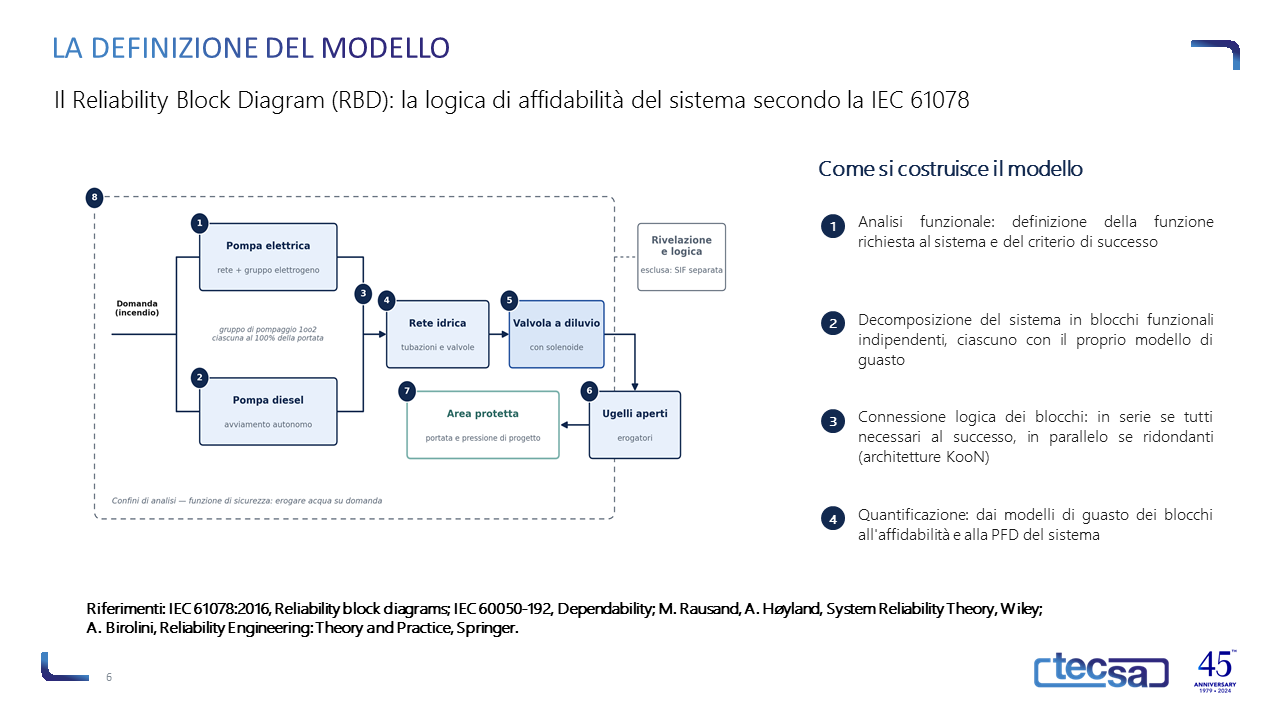
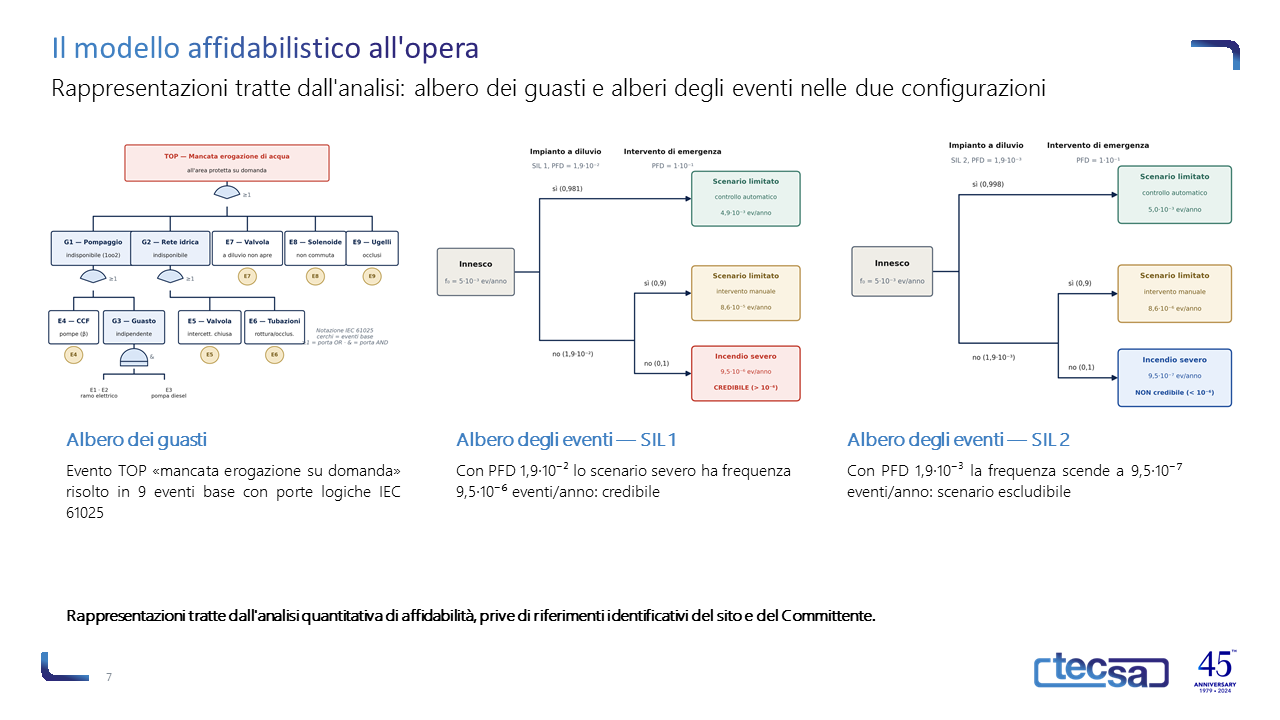
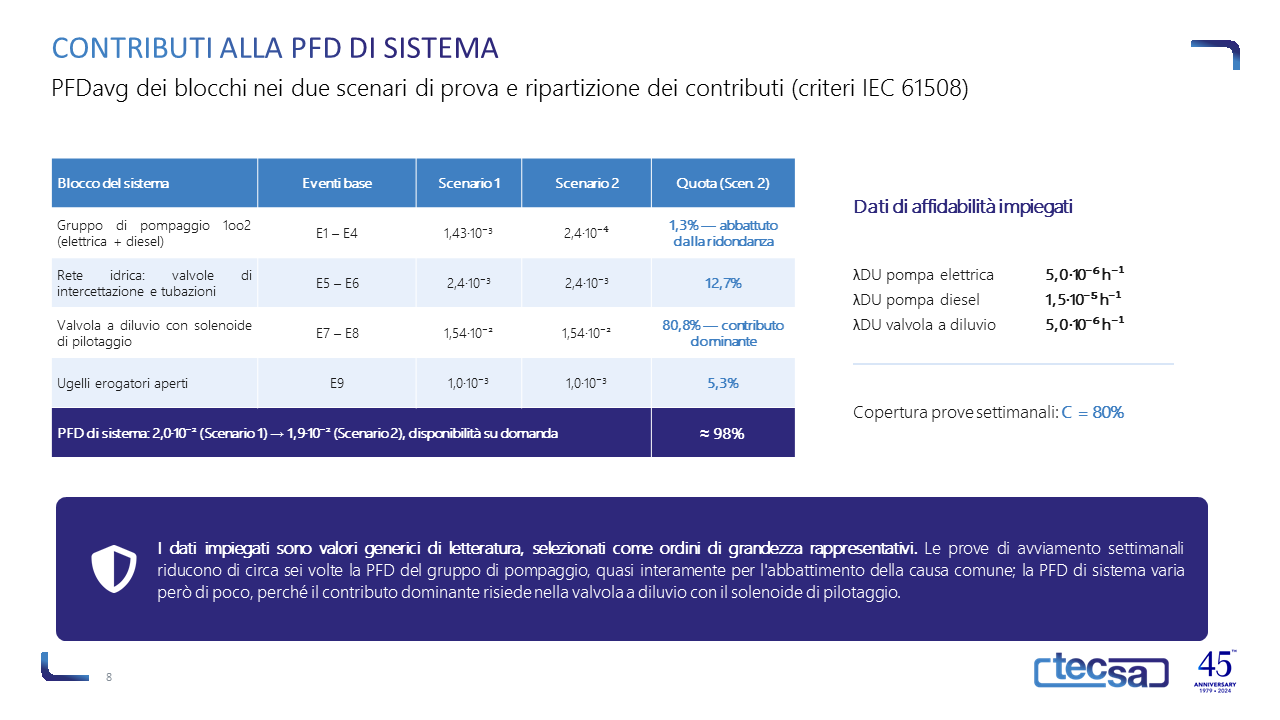
The study, carried out by TECSA for an industrial site, quantified the PFDavg of an active deluge protection system — a 1oo2 configuration pumping unit with an electric pump (mains supply and generator set) and a self-starting diesel pump, water supply network, a deluge valve with a pilot solenoid and open discharge nozzles — in relation to the safety function ‘to supply water at the design flow rates and pressures to the protected area, on demand’. The methodological approach, in accordance with the criteria of standards IEC 61508 and IEC 61511, included the definition of the scope of analysis and conservative assumptions, the construction of the reliability block diagram (RBD) and the fault tree (IEC 61025) with 9 basic events and a common-cause failure of the pumps (β factor of 5% on the geometric mean of failure rates, PDS approach for diversified units), the use of failure rates λDU taken from the OREDA, SINTEF PDS and exida databases, and the evaluation of two test regimes: the six-monthly full functional test alone, and the addition of the weekly pump start-up tests required by UNI EN 12845.
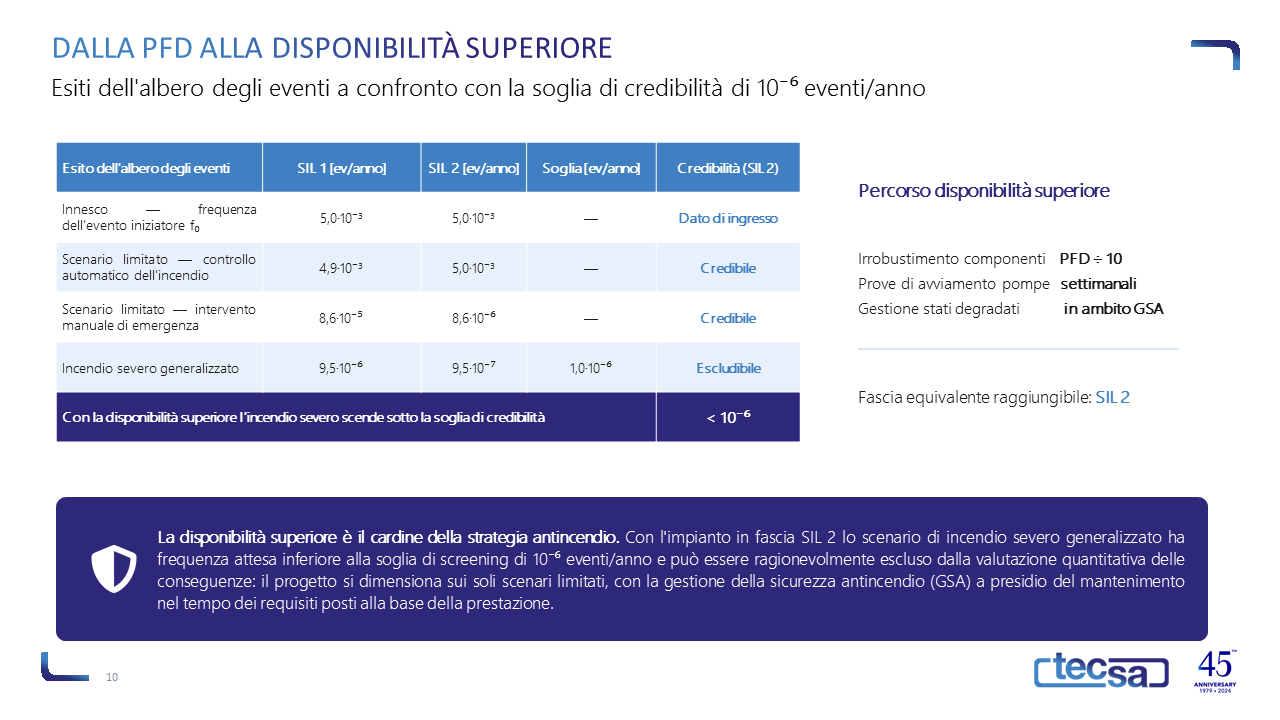
The analysis estimated a system PFD of approximately 2.0·10⁻² with the half-yearly test alone and 1.9·10⁻² with the weekly tests (availability on demand ≈ 98%, equivalent to SIL 1), highlighting that diversified redundancy means the pumping system makes a minor contribution and that approximately 81 per cent of the unavailability lies with the deluge valve and its pilot solenoid: it is on these critical components that improvement measures prove most effective. The inclusion of the PFD in the event tree showed that, in the current configuration, the severe generalised fire scenario has an expected frequency of 9.5×10⁻⁶ events/year, which exceeds the credibility threshold of 10⁻⁶ events/year adopted in line with the practice set out in Legislative Decree 105/2015, whereas with a package of measures to reinforce the critical components, bringing the plant into the SIL 2 category (PFD ≈ 1.9 × 10⁻³), the frequency drops to 9.5 × 10⁻⁷ events per year: the severe scenario can reasonably be excluded from the quantitative consequence assessment, and the design is based solely on the limited scenarios. The study has thus defined the technical and managerial approach — targeted reinforcement, calibrated periodic testing and monitoring of degraded states within the GSA framework — to qualify the plant as a system with superior availability in accordance with the Fire Prevention Code.