The Supervisory Body pursuant to Legislative Decree 231/01 of the company that leases and manages a large-scale shopping centre — an activity subject to fire prevention inspections under Presidential Decree 151/2011 and also managed through a property and facility management company and a network of contractors — has commissioned TECSA, together with an independent academic expert, to conduct a fire prevention audit of the premises. The purpose of the audit was not only to highlight and establish the level of fire safety achieved, but also to provide the Supervisory Body with an objective and independent document capable of demonstrating regulatory compliance, substantive compliance and proper management by the appointed company, in support of the monitoring of the Organisation, Management and Control Model.
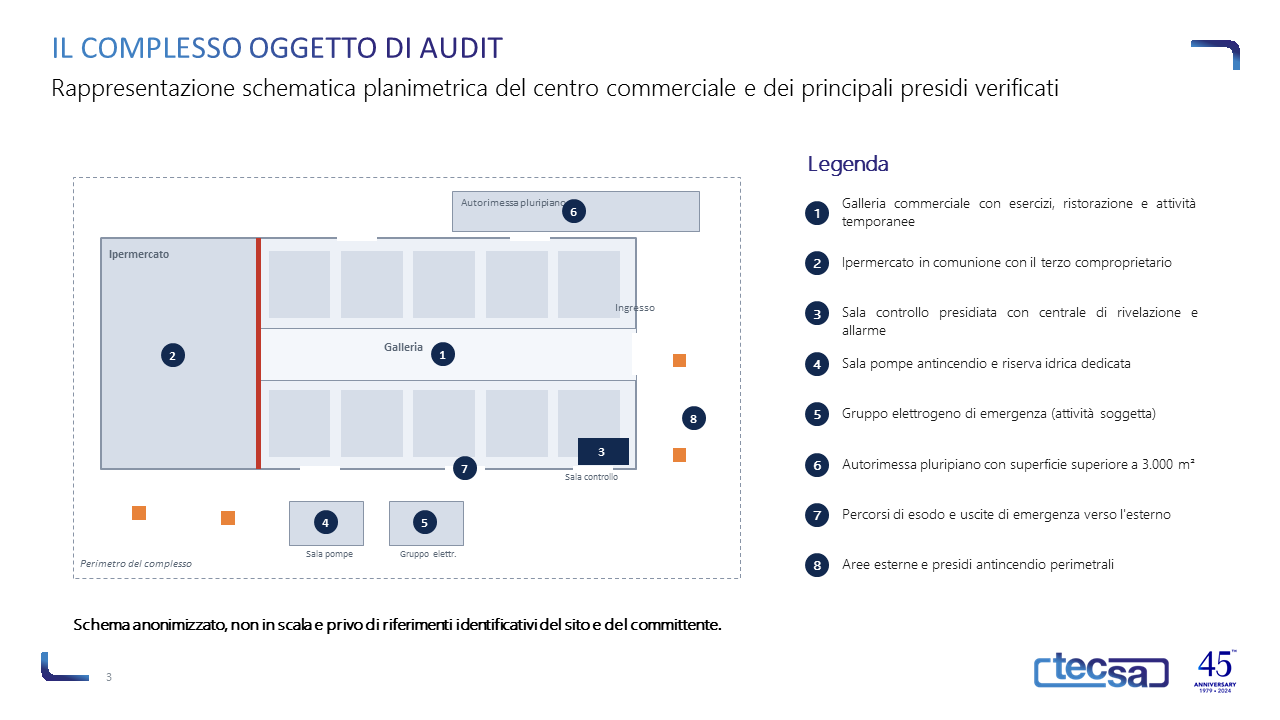
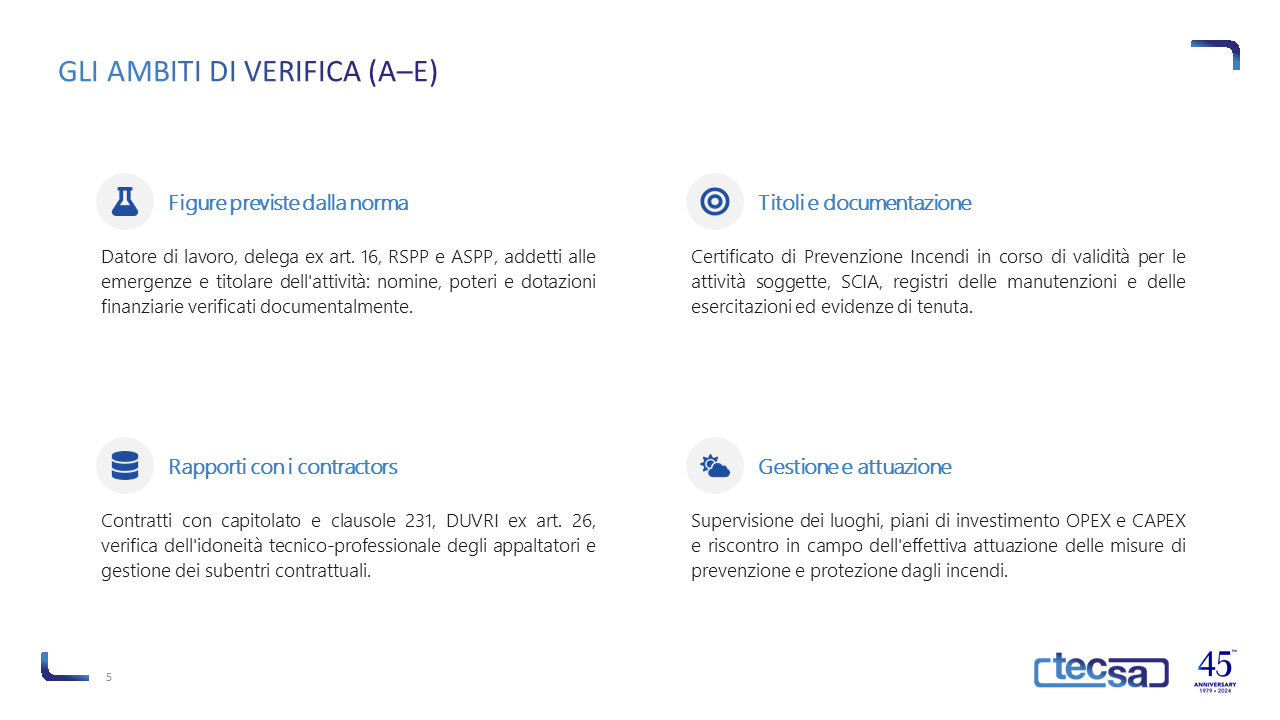
The audit was conducted using a risk-based methodology across five areas of assessment: identification of the roles required by law (employer, delegate pursuant to Article 16 of Legislative Decree 81/08, RSPP and ASPP, emergency response personnel, business owner); maintenance of authorisation certificates and documentation (valid Fire Prevention Certificate for the five activities surveyed, SCIA, maintenance and drill logs); relations with contractors (contracts including specifications and Article 231 clauses, DUVRI pursuant to Article 26, technical and professional suitability); management and supervision of the premises; implementation of prevention and protection measures. The audit involved reviewing over fifteen documents, conducting interviews with key personnel from the property owners, the asset management company (SGR), the operator and the contractors, and carrying out an unannounced inspection covering ten areas of the complex — from the control room to the pump room, from the escape routes to the car park — with the final findings presented to those interviewed.
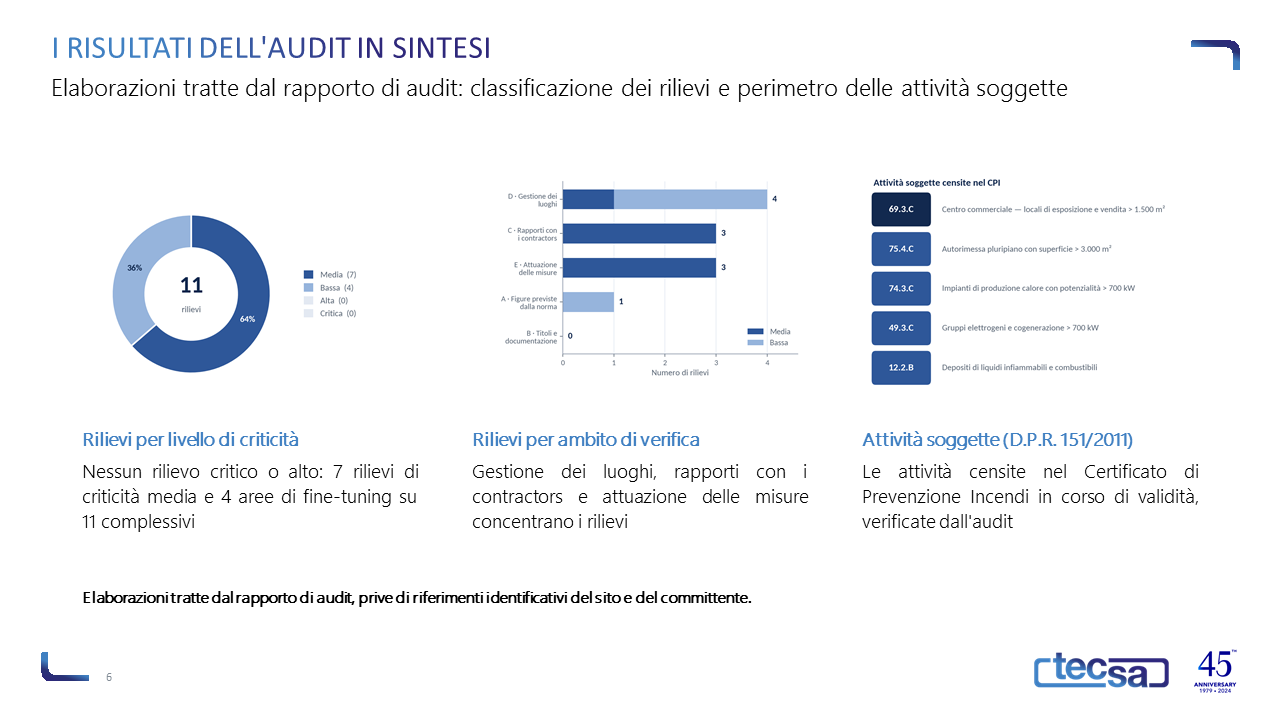
The audit identified 11 findings, classified into four levels of severity and linked to documentary and on-site evidence: no critical or high-severity findings, seven findings of medium severity and four areas requiring fine-tuning, focusing on updating contractual arrangements following a change of ownership, site management and the implementation of fire safety measures, whilst delegations of authority and appointments were formally correct, authorisation certificates were valid and fire safety records were duly maintained. Furthermore, during the audit, significant measures were found to have already been implemented, such as the replacement of detection control units and over 900 detectors that had reached the end of their service life. The report thus provides the Supervisory Body with an objective tool for monitoring the implementation of the 231 Model and corrective actions, confirming TECSA’s ability to conduct independent fire safety audits on complex property portfolios and premises open to the public.