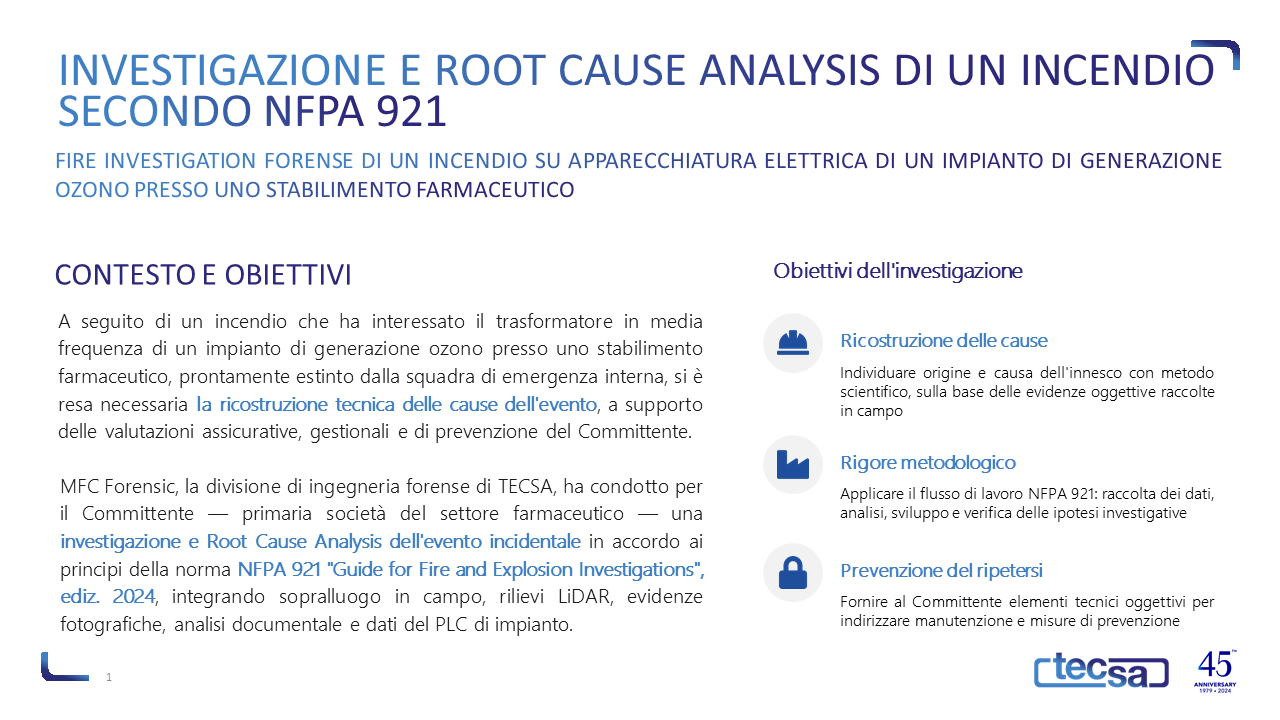
Following a fire involving the medium-frequency transformer of an ozone generation system serving the process equipment at a pharmaceutical plant, which was promptly extinguished by the in-house emergency response team, the Client commissioned MFC Forensic — TECSA’s forensic engineering division — to scientifically reconstruct the possible causes of the incident, to support insurance, management and prevention assessments. The fire damaged the transformer compartment inside the equipment’s electrical switchboard, leaving carbonised residues on components, wiring and electronic equipment in the control section.
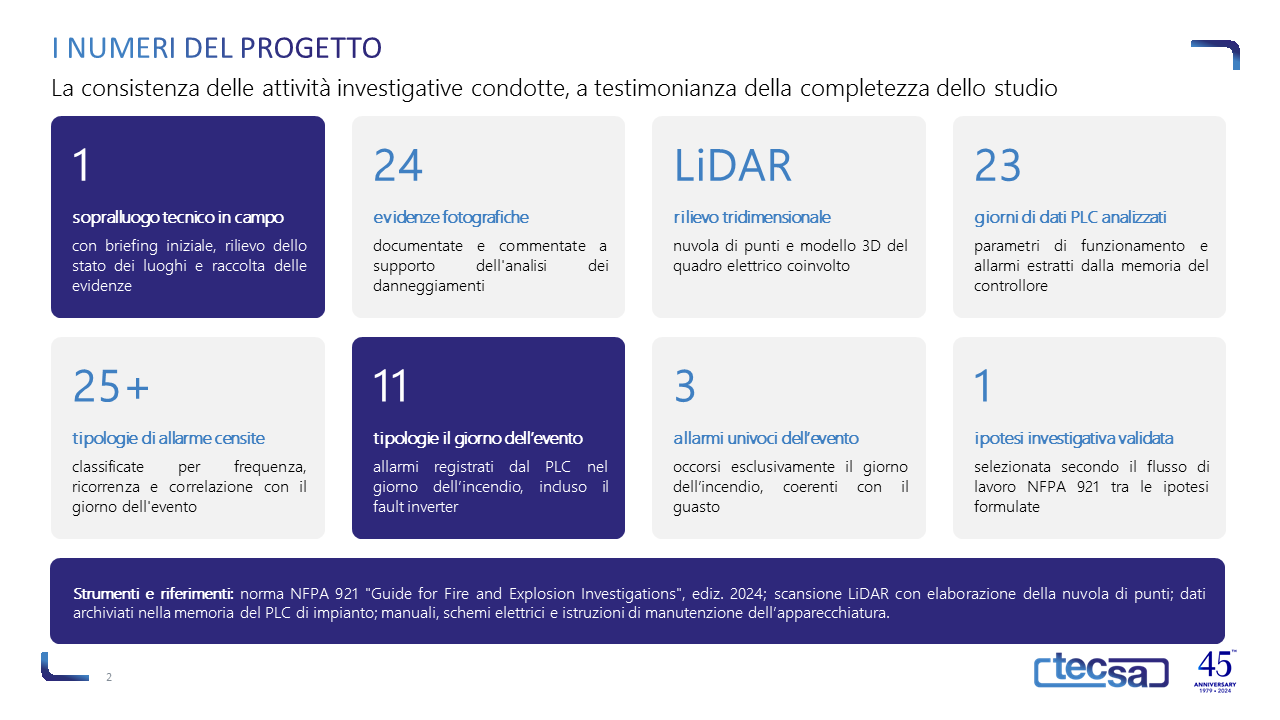
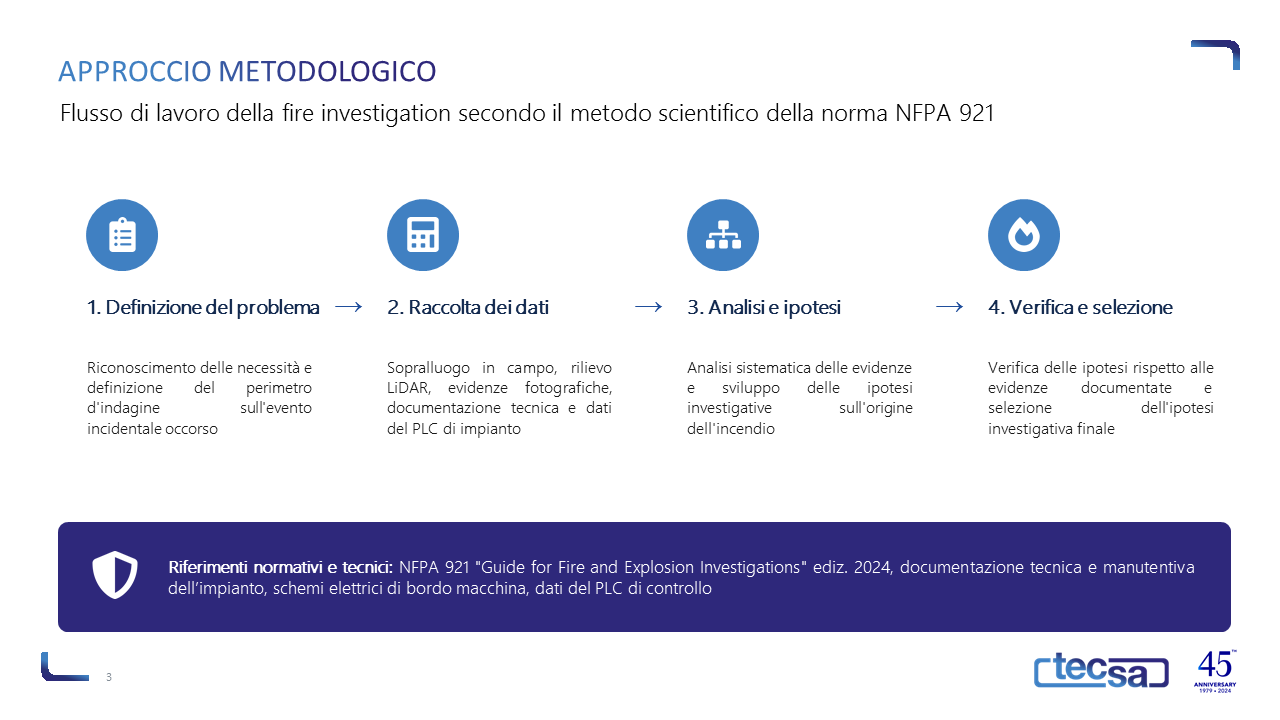
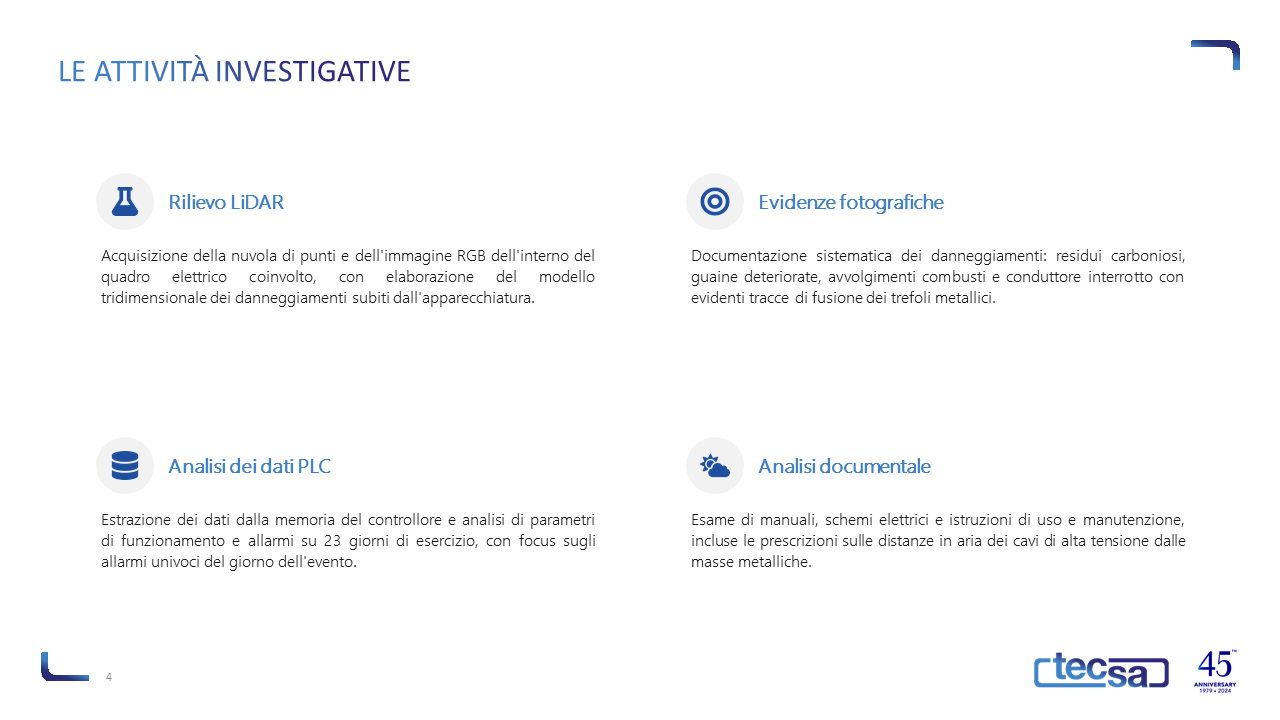
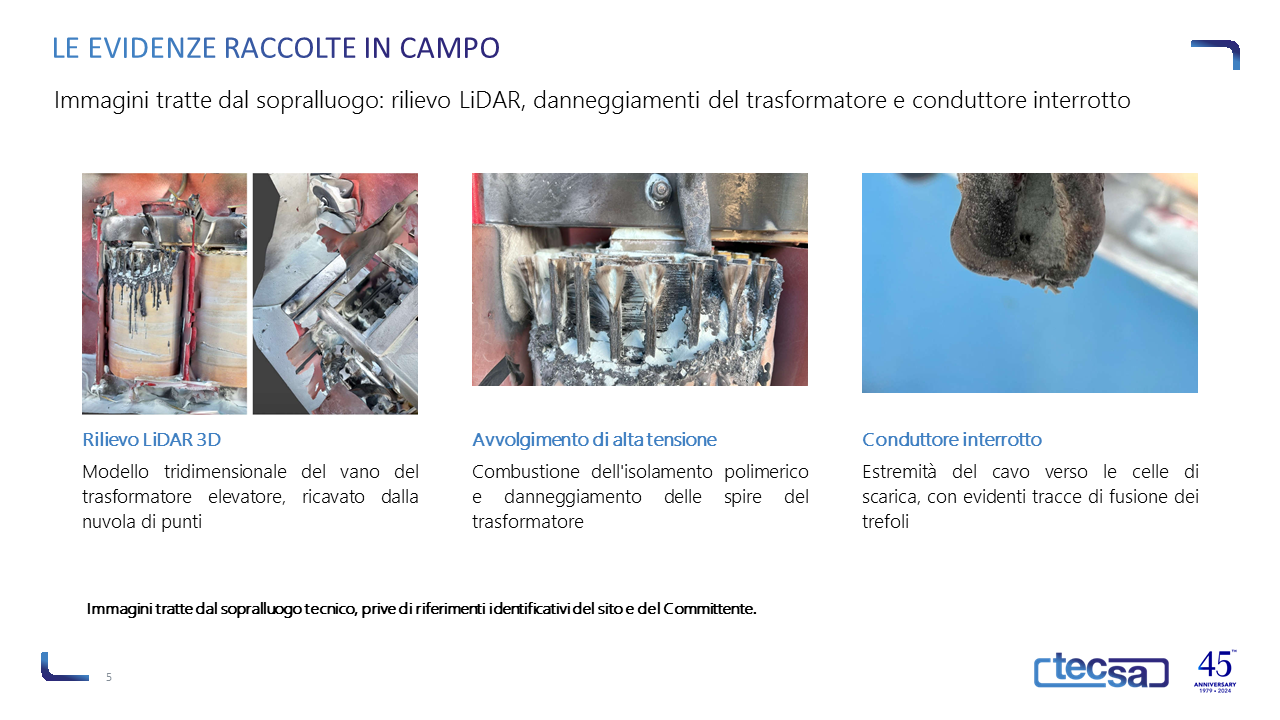
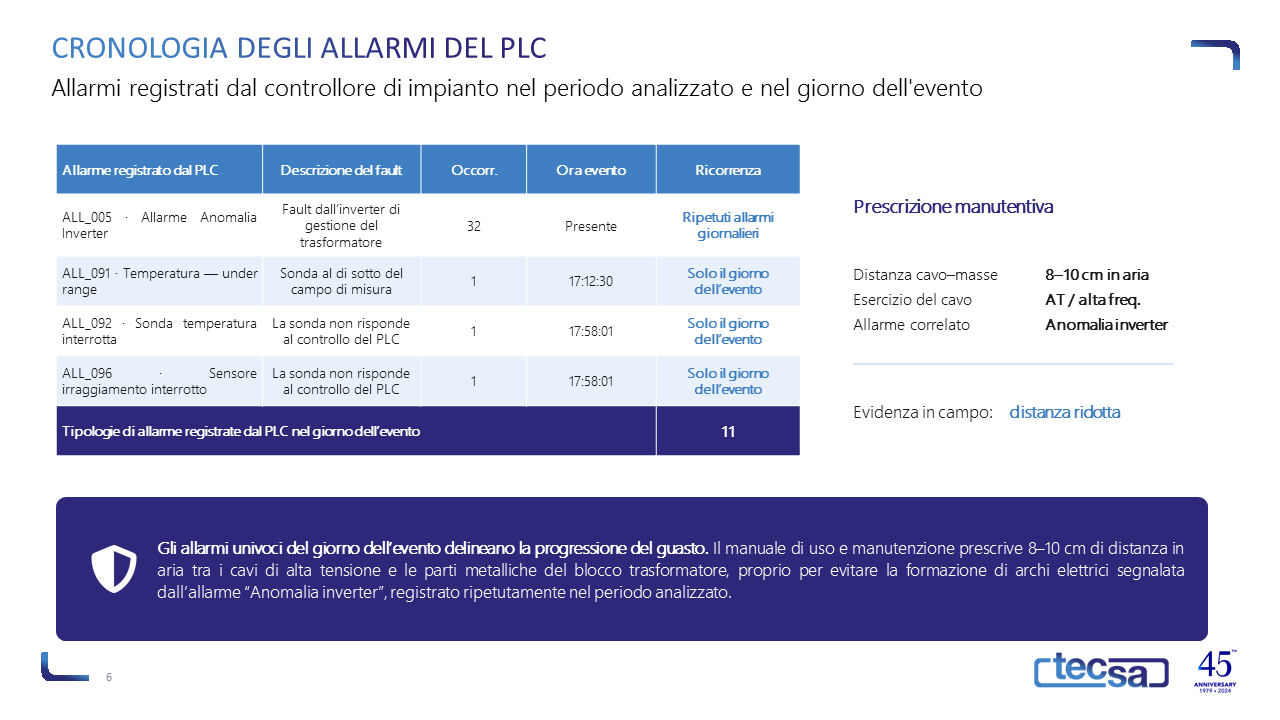
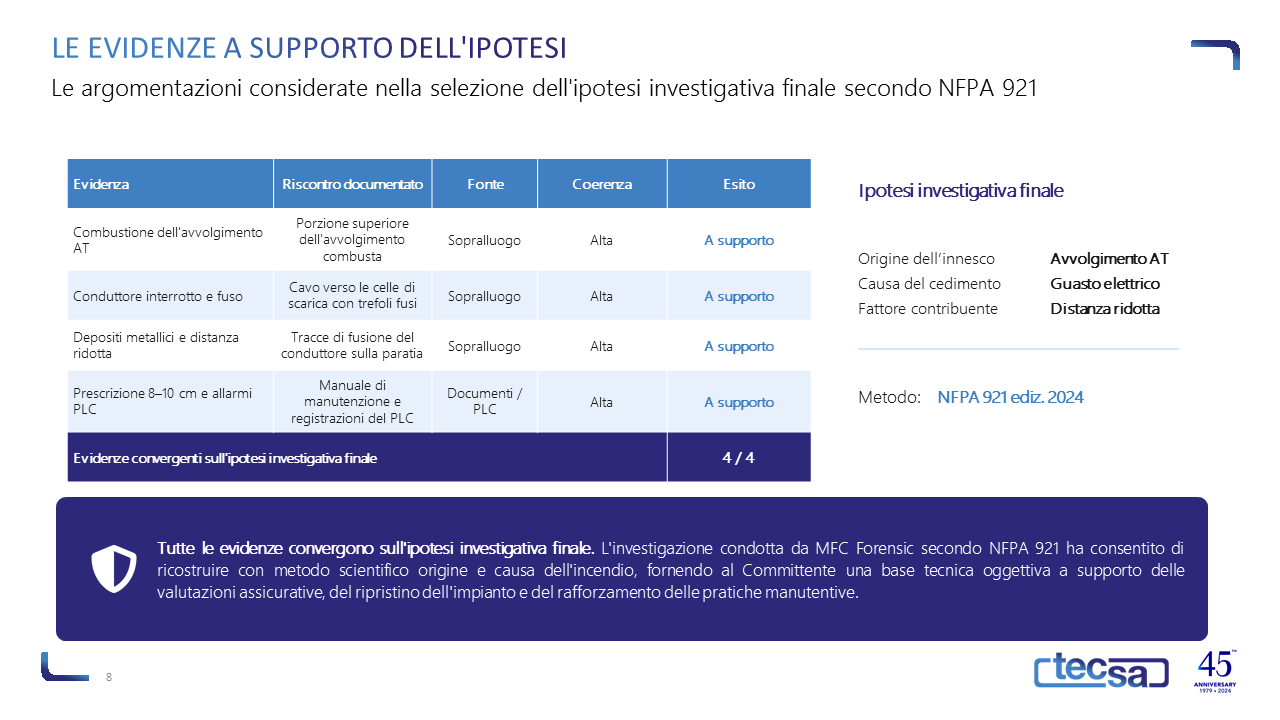
The investigation was conducted in accordance with the principles of the international technical standard NFPA 921 “Guide for Fire and Explosion Investigations”, 2024 edition, which defines the scientific and systematic method of forensic fire investigation: problem definition, data collection, analysis, development of investigative hypotheses, their verification and selection of the final hypothesis. The activities included an on-site technical inspection with an initial briefing, a LiDAR survey of the site with processing of the point cloud and the three-dimensional model of the equipment involved, systematic photographic documentation of the damage (24 annotated findings), analysis of technical and maintenance documentation (manuals, circuit diagrams, operating and maintenance instructions); and the extraction and analysis of data stored in the plant’s PLC memory covering 23 days of operation, with the classification of over 25 types of alarm by frequency, recurrence and correlation with the day of the incident.
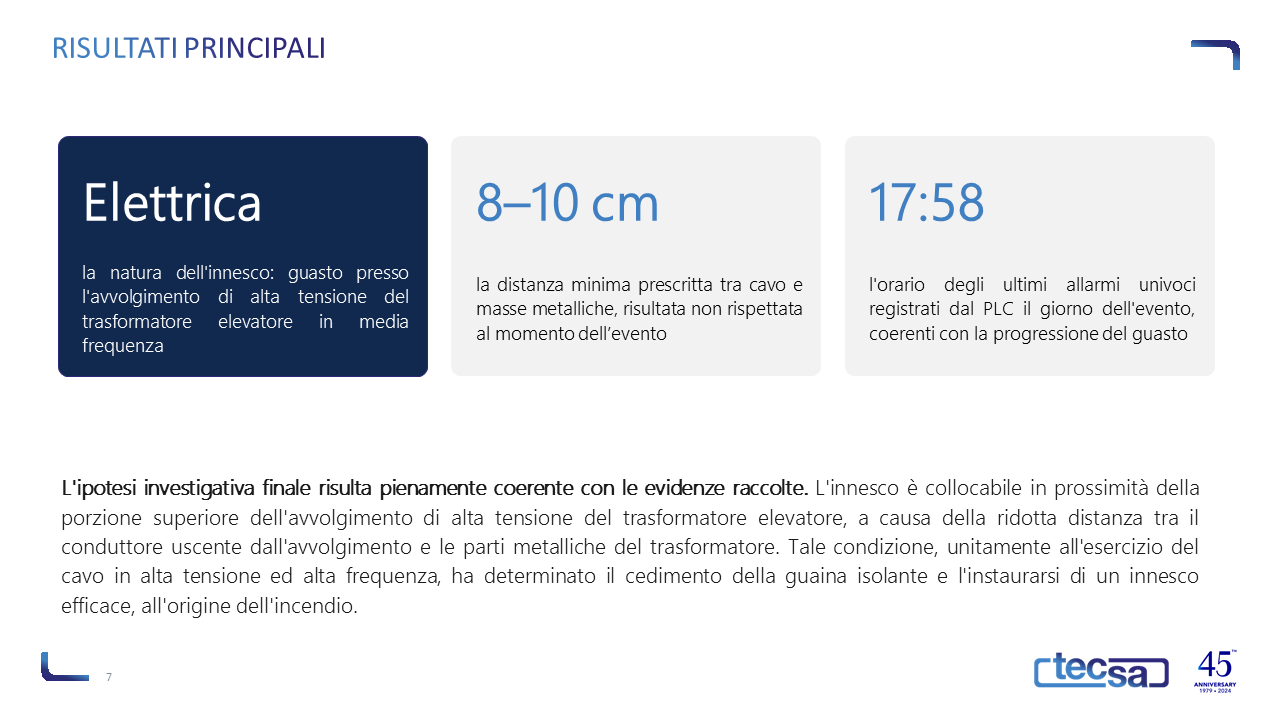
Cross-referencing the evidence enabled the final investigative hypothesis to be selected from among those formulated: an electrical ignition near the upper portion of the high-voltage winding of the step-up transformer, caused by the reduced distance between the conductor emerging from the winding and the metal parts of the transformer, compared with the air gap of 8–10 cm prescribed by the maintenance manual specifically to prevent the formation of electric arcs. This condition, combined with the cable operating at high voltage and high frequency, led to the failure of the insulating sheath and the establishment of a sustained arc. The hypothesis was found to be fully consistent with all the documented evidence: the combustion of the winding, the conductor found to be broken with traces of melted strands, the metallic deposits on the side bulkhead, the maintenance requirement, and the alarms recorded by the PLC on the day of the incident, including the fault in the transformer control inverter and three unambiguous alarms consistent with the progression of the fault. The study provided the Client with an objective technical basis to support insurance assessments, the restoration of the plant and the strengthening of maintenance procedures, demonstrating MFC Forensic’s expertise in investigating complex incident events.