Background
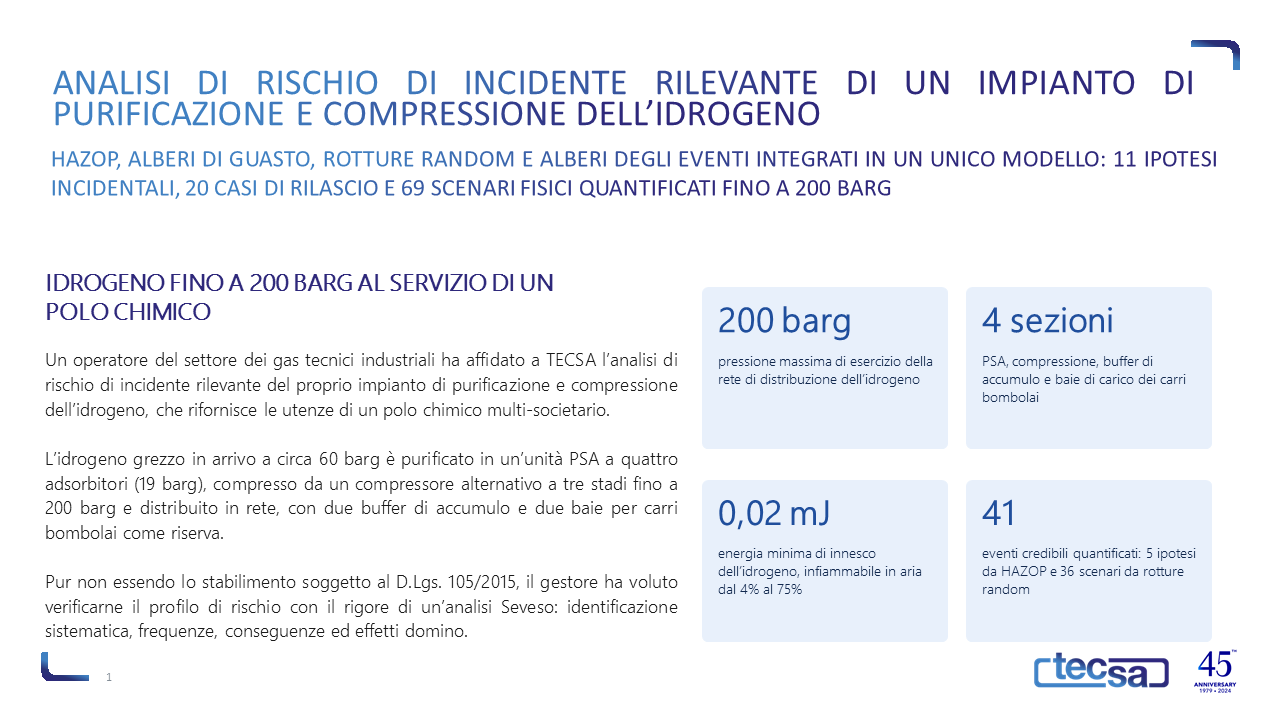
An operator in the industrial technical gases sector commissioned TECSA to carry out a major accident risk analysis of its hydrogen purification and compression plant, which supplies a multi-company chemical complex. The plant purifies raw hydrogen in a PSA unit with four adsorbers, compresses it using a three-stage reciprocating compressor up to 200 barg, and distributes it via the network, utilising two storage buffers and two bays for cylinder trucks. Although the plant is not subject to Legislative Decree 105/2015, the operator has chosen to assess its risk profile with the rigour of a Seveso analysis.
The approach
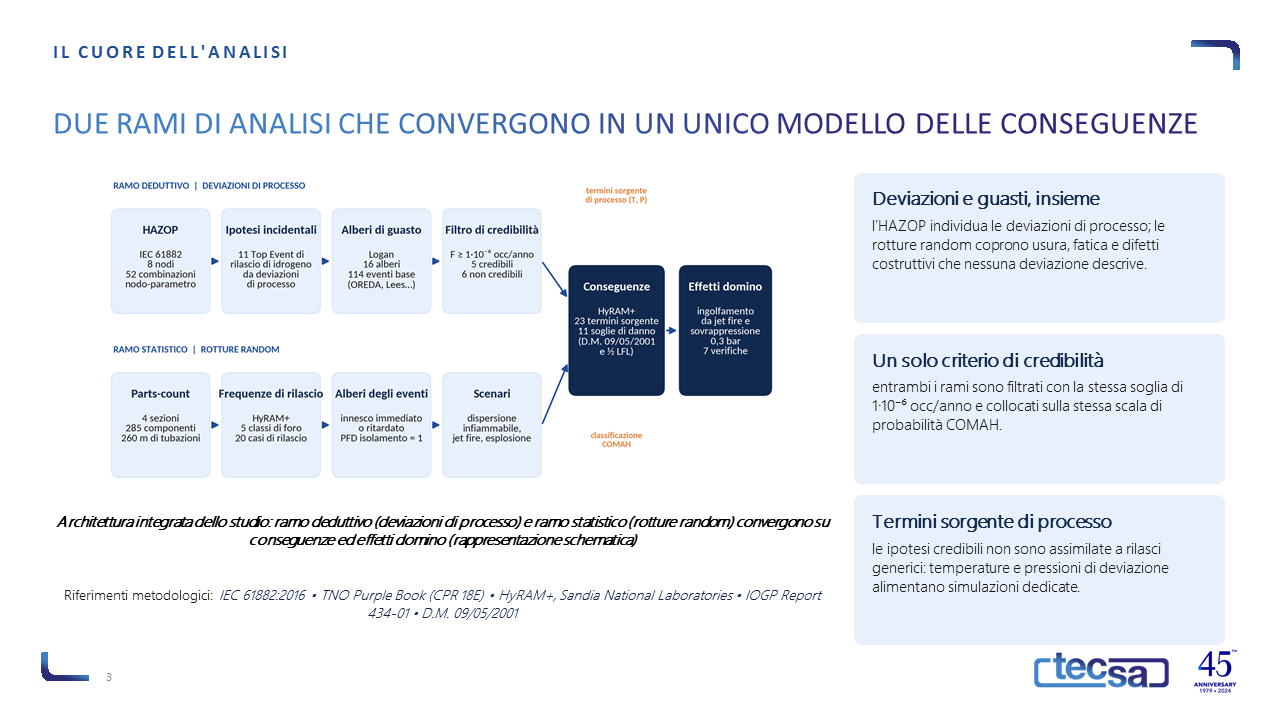
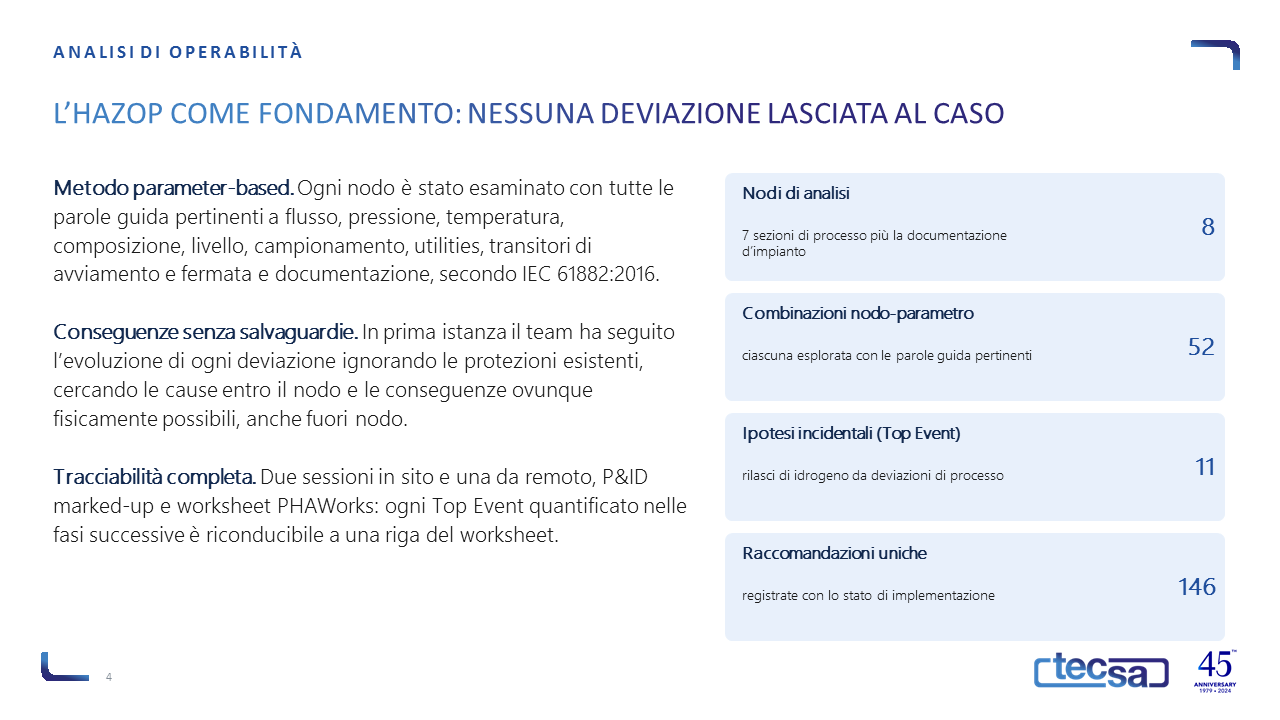
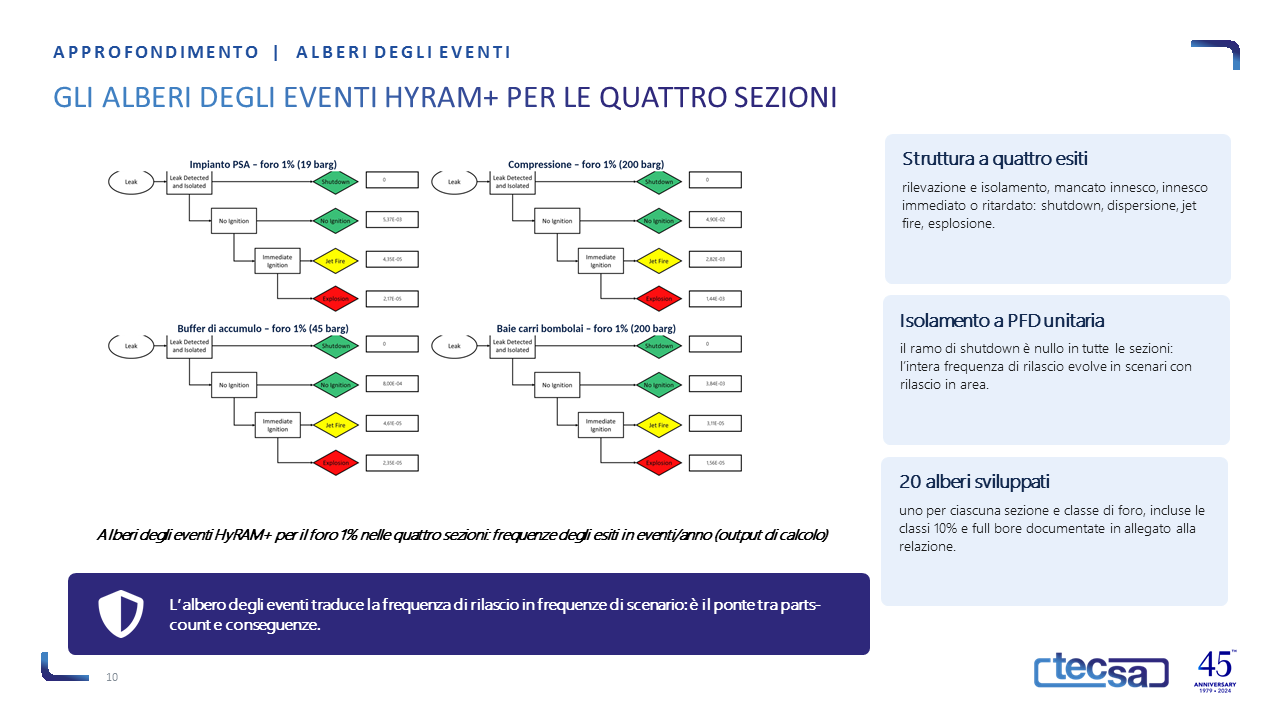
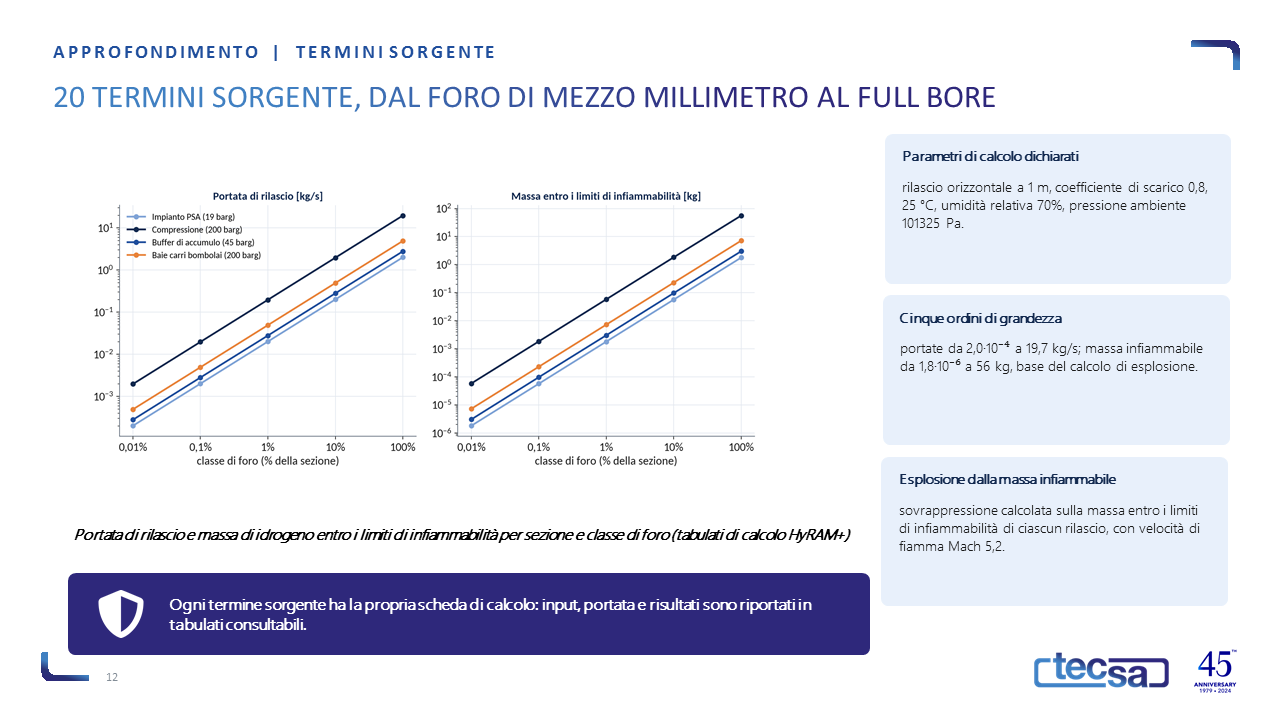
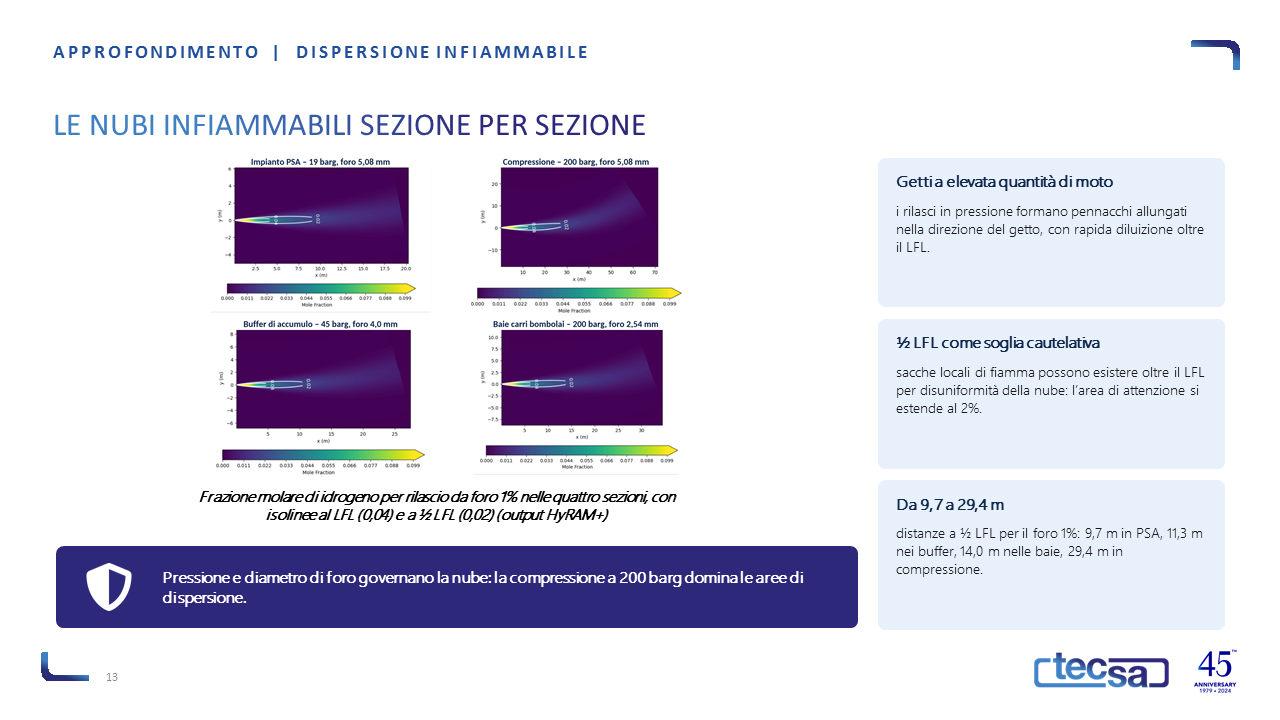
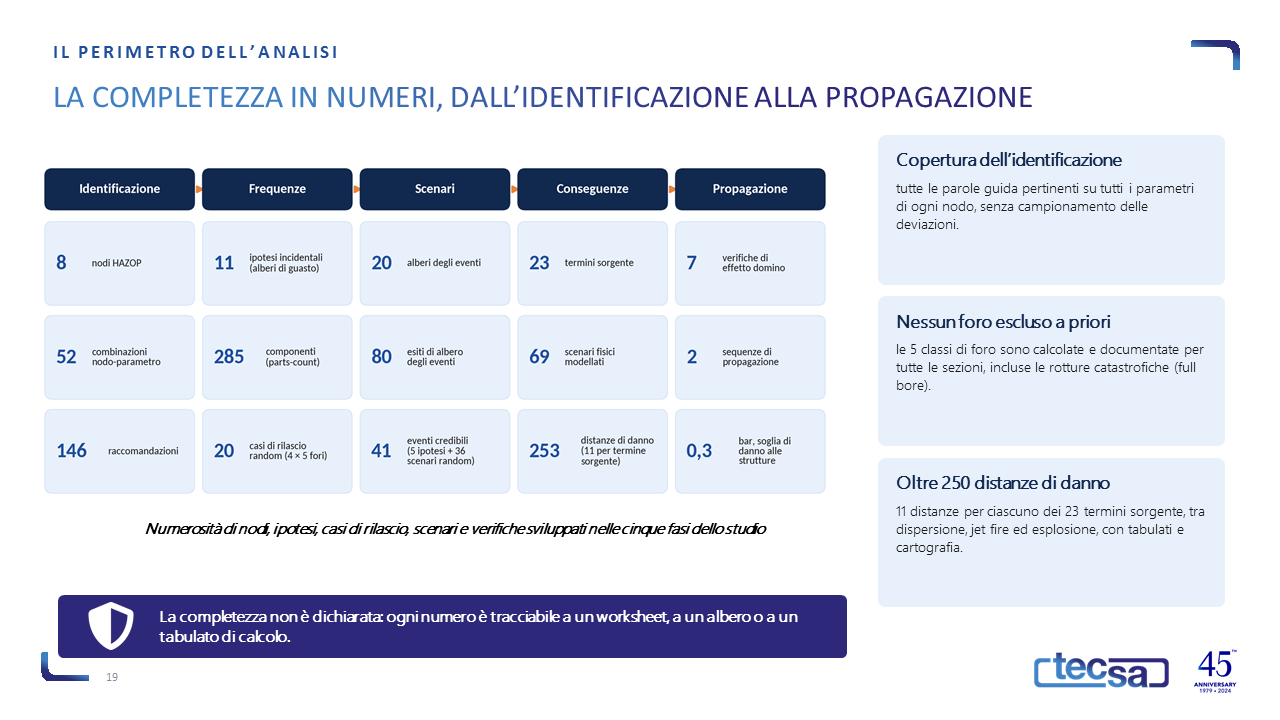
The study integrates six techniques into a single two-branch model. In the deductive branch, a HAZOP analysis conducted in accordance with IEC 61882 on 8 nodes and 52 node-parameter combinations identified 11 accident scenarios involving hydrogen release, quantified using 16 fault trees (Logan code) and 114 base events derived from OREDA, Lees, exida and operational data. In the statistical branch, the parts-count of 285 components across 4 sections was fed into Sandia National Laboratories’ HyRAM+ toolkit for 5 borehole classes, up to full-bore rupture: 20 release scenarios were developed using event trees for flammable dispersion, jet fire and explosion.
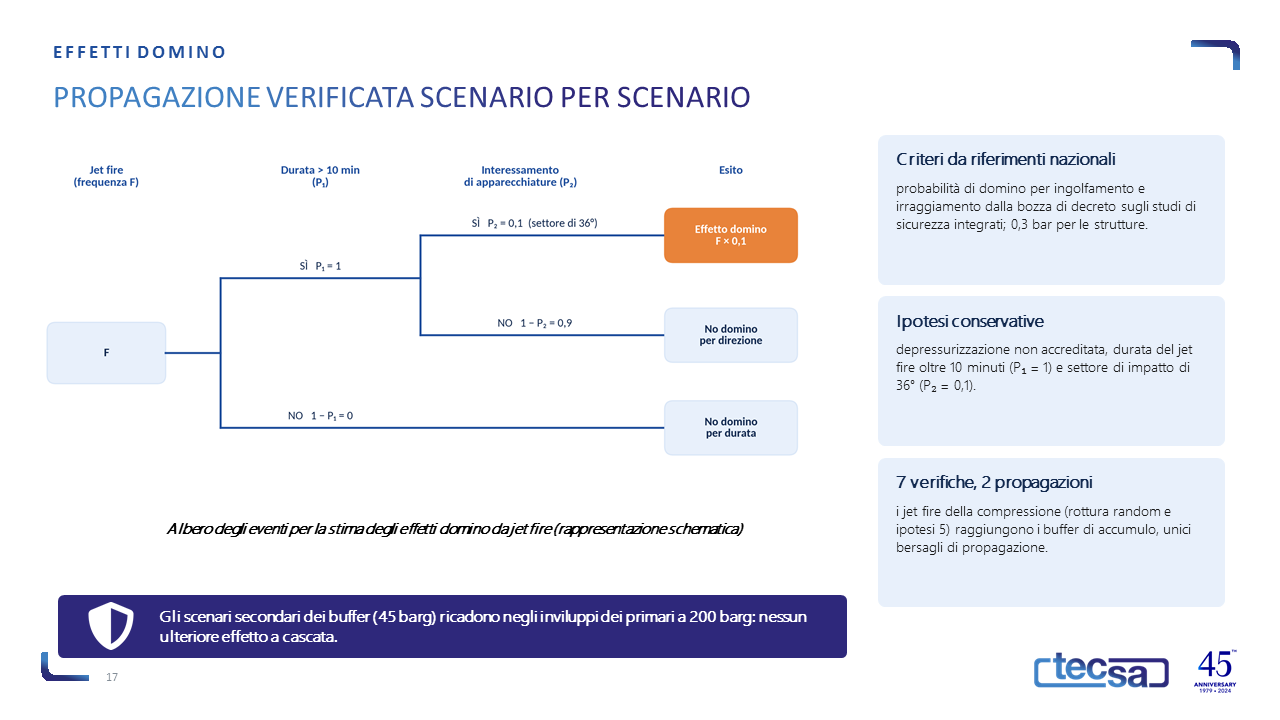
Both branches were filtered using the same credibility threshold of 1·10⁻⁶ occurrences per year and mapped to the COMAH probability classes. Consequences were calculated for 23 source terms, including those specific to process deviations, using the thresholds set out in the Ministerial Decree of 9 May 2001 and the ½ LFL; domino effects were assessed using the criteria set out in the draft decree on integrated safety studies.
The results
Of the 11 accident scenarios, 5 were found to be credible and were analysed through to their consequences, whilst 6 were ruled out on quantitative grounds, across a frequency range spanning nine orders of magnitude. All 36 random rupture scenarios were found to exceed the credibility threshold. The most extensive jet fire, originating from the compression section, measures 7.7 m, with a radiant heat flux of 3 kW/m² within 11 m. Of the 7 domino analyses, only two sequences involve the accumulation buffers: the operator thus has a comprehensive, traceable risk profile based on the stated conservative assumptions.
Why TECSA
TECSA offers a single point of contact for the entire hydrogen risk analysis process: hazard identification, fault trees, release statistics, codes dedicated to consequences and domino effects, with every figure traceable to a worksheet, a fault tree or a calculation report.