The context
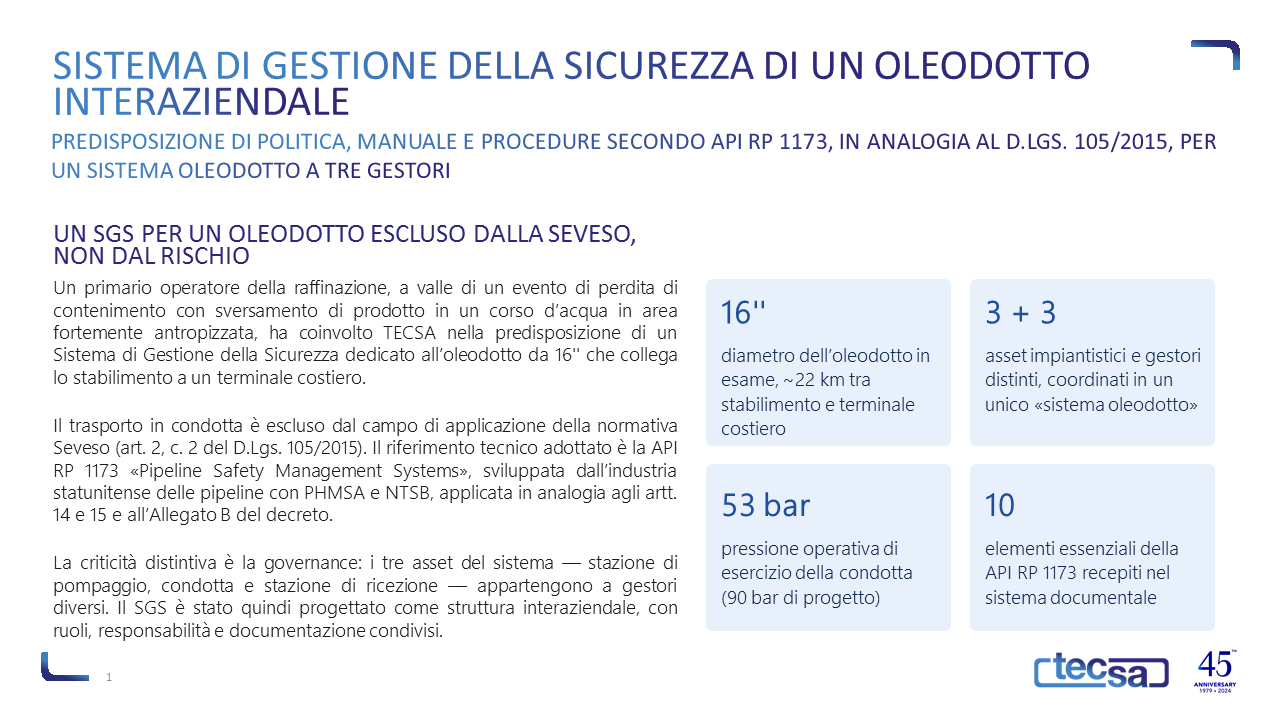
A leading refining operator, following a containment failure incident involving a product spill into a watercourse in a heavily populated area, engaged TECSA to develop a Safety Management System for a 16-inch pipeline approximately 22 km long, connecting the refinery to a coastal terminal. Pipeline transport is excluded from the scope of the Seveso regulations (Article 2, paragraph 2 of Legislative Decree 105/2015) and the key challenge of the assignment lies in governance: the three assets comprising the system — the pumping station, the pipeline and the receiving station — are owned by different operators.
The approach
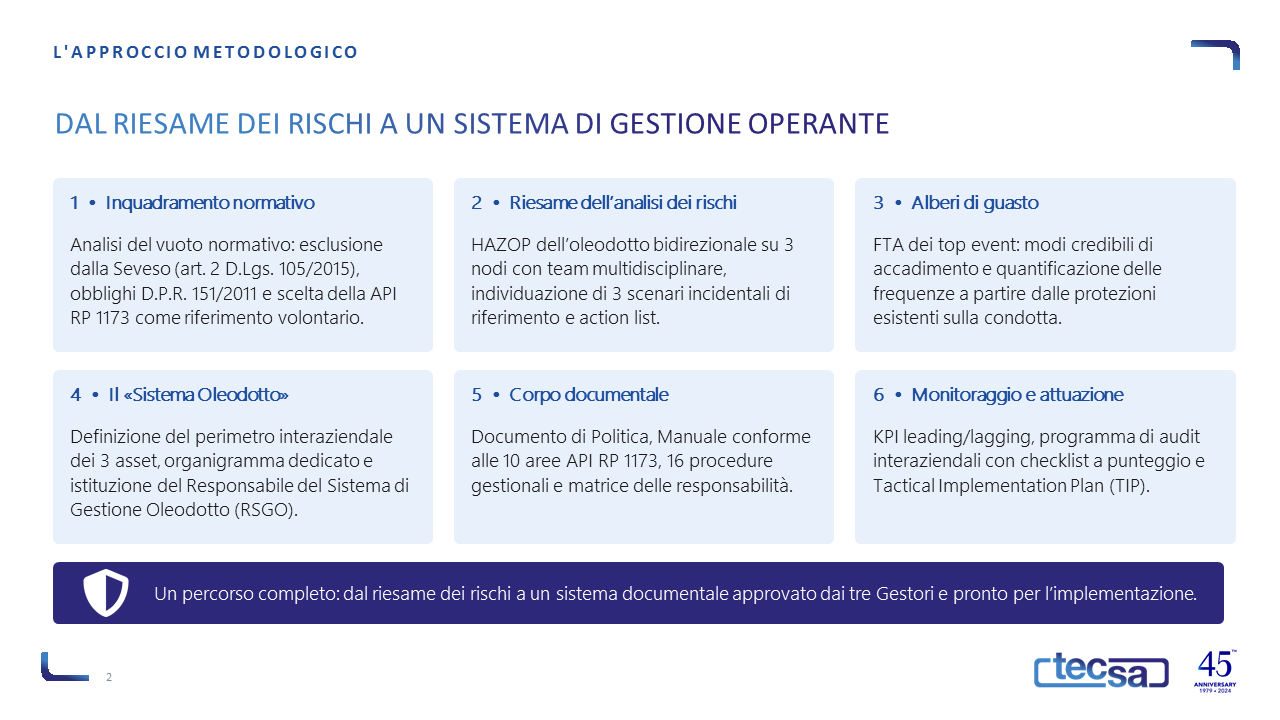
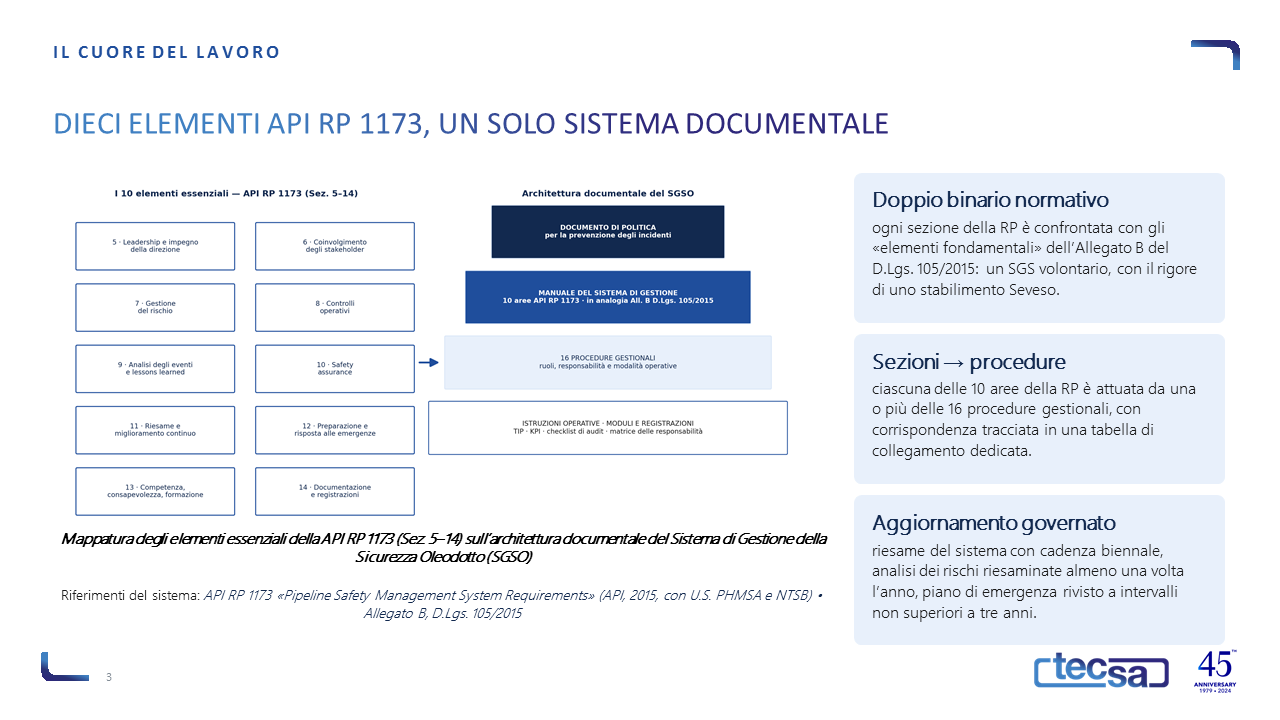
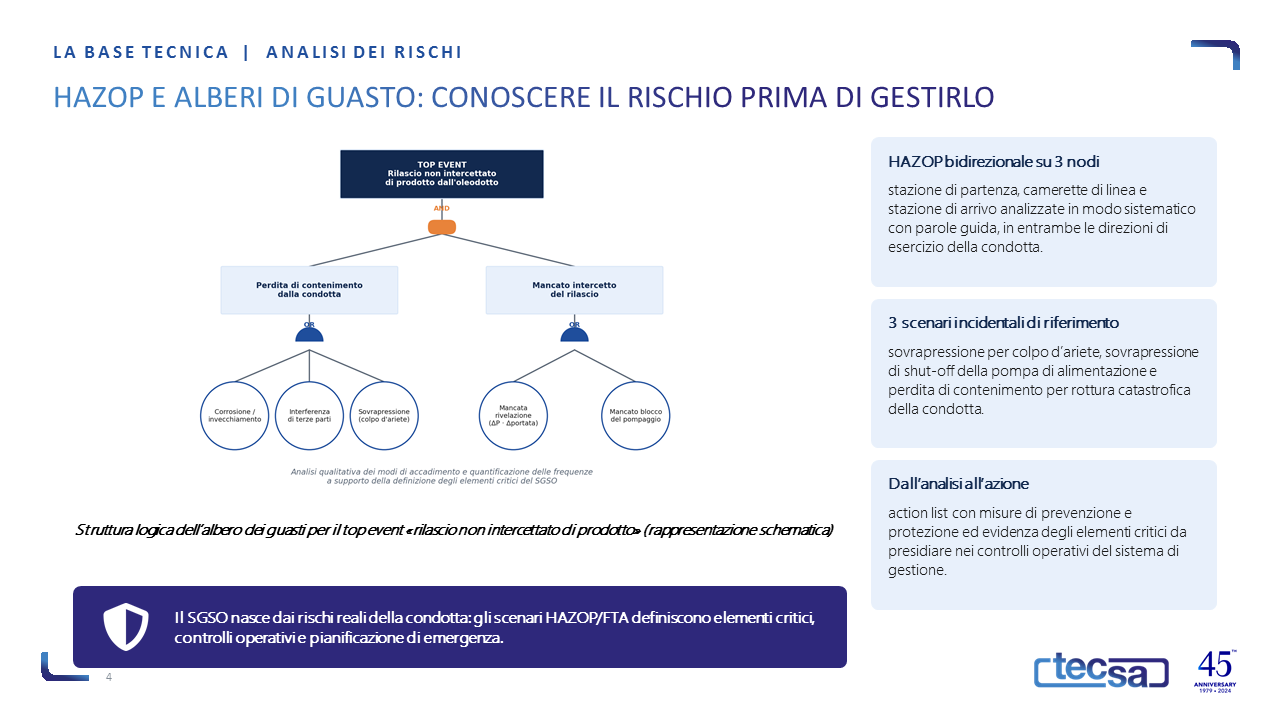
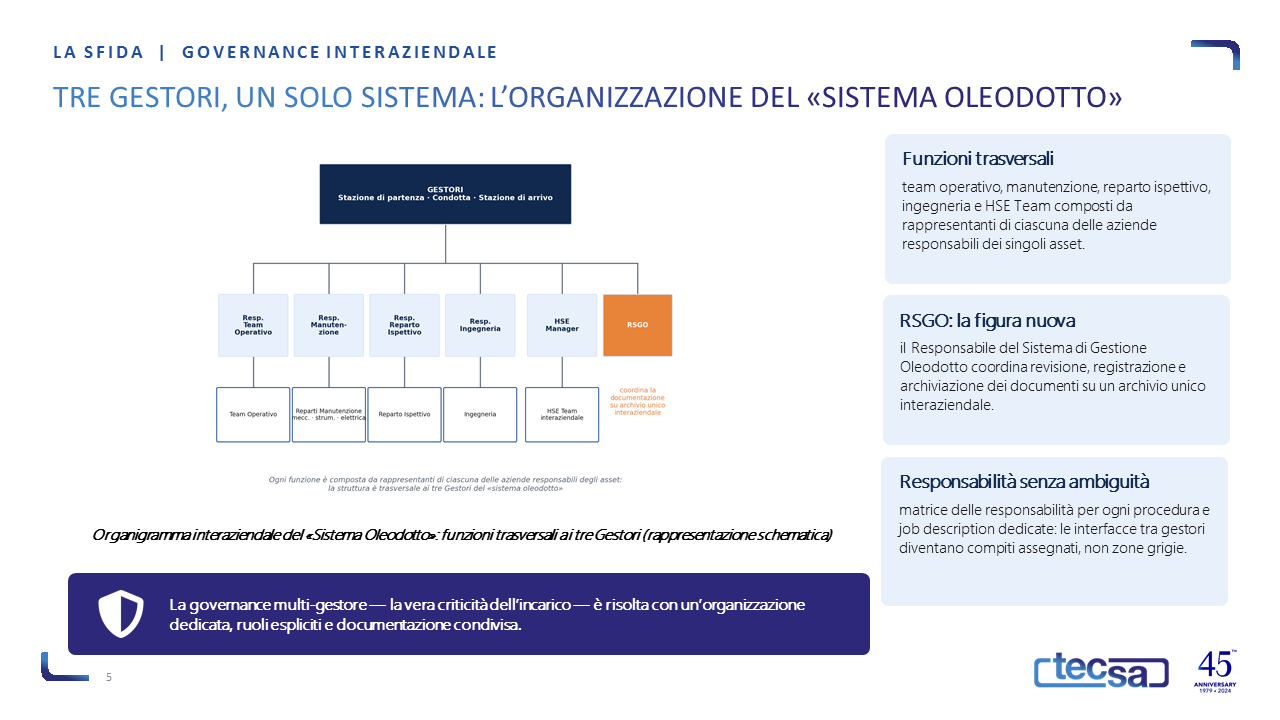
API RP 1173 ‘Pipeline Safety Management System Requirements’, developed by the US pipeline industry in collaboration with PHMSA and the NTSB, was adopted as the technical reference and applied by analogy to Articles 14 and 15 and Annex B of Legislative Decree 105/2015: a voluntary system, designed with the rigour required of establishments at risk of a major accident. The work began with a review of the risk analysis — a HAZOP study of the bidirectional pipeline across three nodes, identifying three reference accident scenarios, failure trees for the top events and action lists — before defining the cross-organisational scope of the ‘Pipeline System’, with an organisational chart spanning the three Operators and the appointment of the Pipeline Management System Manager (RSGO), who oversees a single document repository.
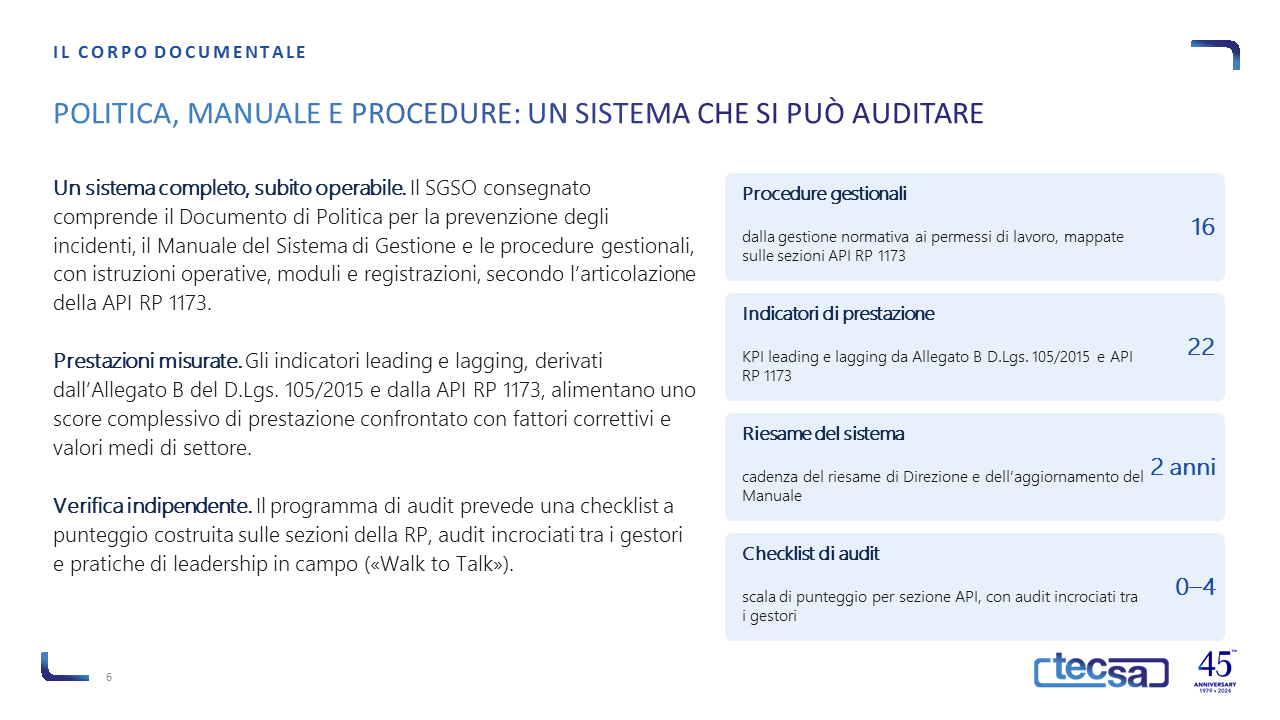
On this basis, the complete set of documents was drawn up: the Accident Prevention Policy Document, the Management System Manual structured around the 10 essential elements of API RP 1173, and 16 management procedures, including a responsibility matrix, operational instructions, forms and records.
The results
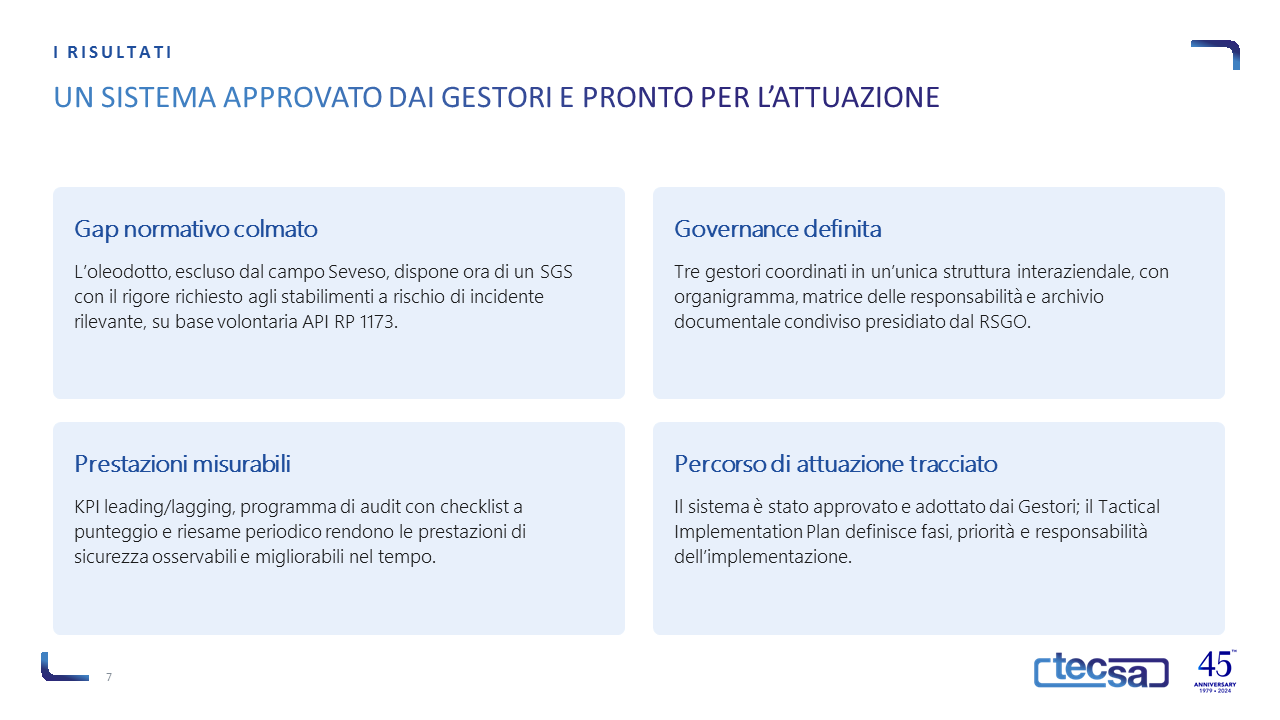
The system delivered is measurable and verifiable: 22 leading and lagging performance indicators, derived from Annex B of Legislative Decree 105/2015 and API RP 1173; a programme of inter-company audits with a scored checklist (scale 0–4) based on the sections of the recommended practice; leadership practices in the field (‘Walk to Talk’) and a biennial management review. The SGSO has been approved and adopted by the Operators, with a Tactical Implementation Plan defining the phases, priorities and responsibilities for implementation.
Why TECSA
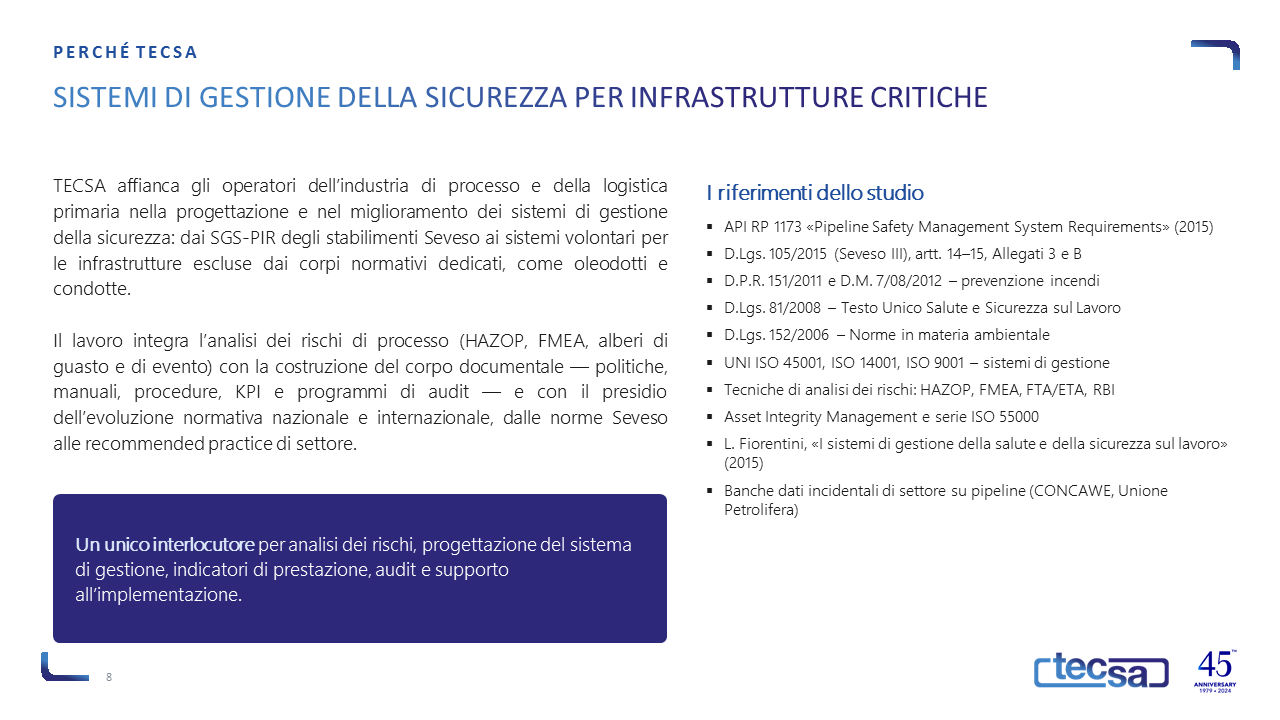
TECSA supports operators in the process industry and primary logistics sector in the design and improvement of safety management systems: from SGS-PIR systems for Seveso-designated sites to voluntary systems for infrastructure not covered by dedicated regulatory frameworks, such as oil pipelines and conduits. A single point of contact for risk analysis, documentation development, performance indicators, audits and implementation support.