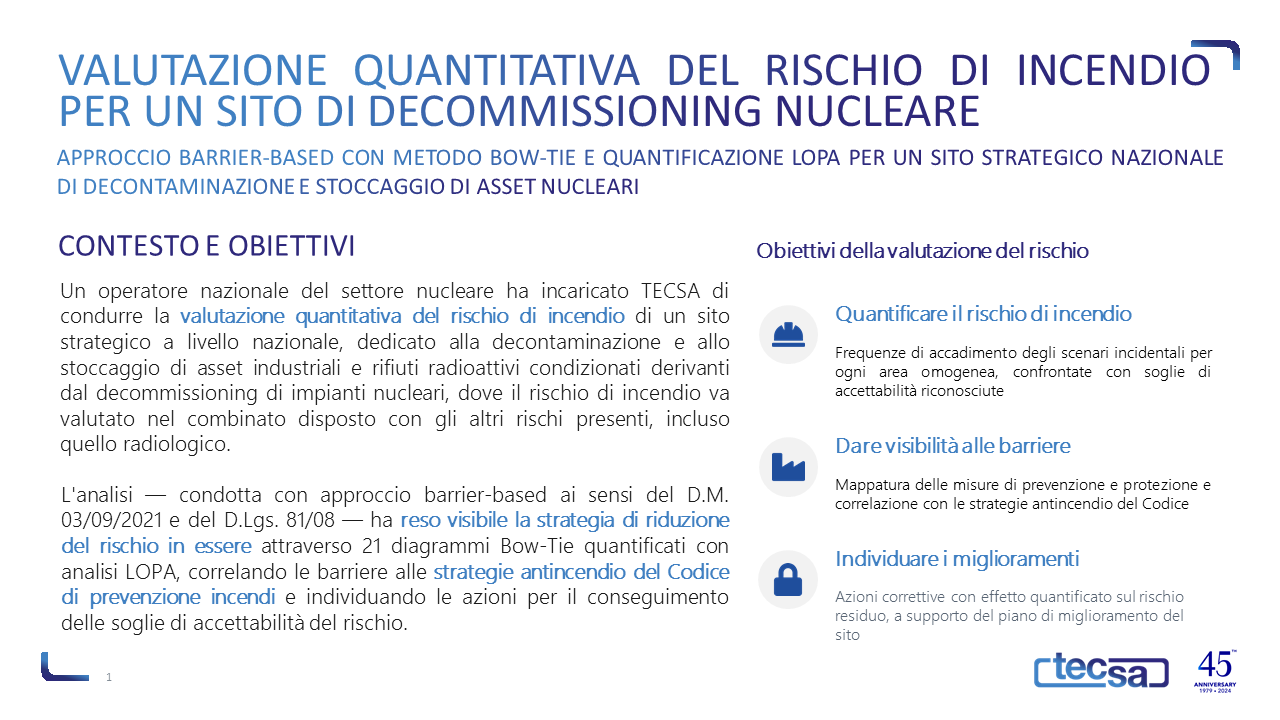
A national operator in the nuclear sector commissioned TECSA to carry out a quantitative fire risk assessment of a site of national strategic importance, dedicated to decontamination activities and the storage of industrial assets and conditioned radioactive waste resulting from the decommissioning of nuclear facilities: a context in which fire risk must necessarily be assessed in conjunction with other present risks, including those associated with radioactivity. The assessment, prepared in accordance with Ministerial Decree of 3 September 2021 and Legislative Decree 81/08 as an integral part of the Risk Assessment Document, was carried out using a ‘barrier-based’ approach based on the Bow-Tie method, which served as the main component for structuring the information and measuring the degree of risk reduction provided by the barriers actually in place.
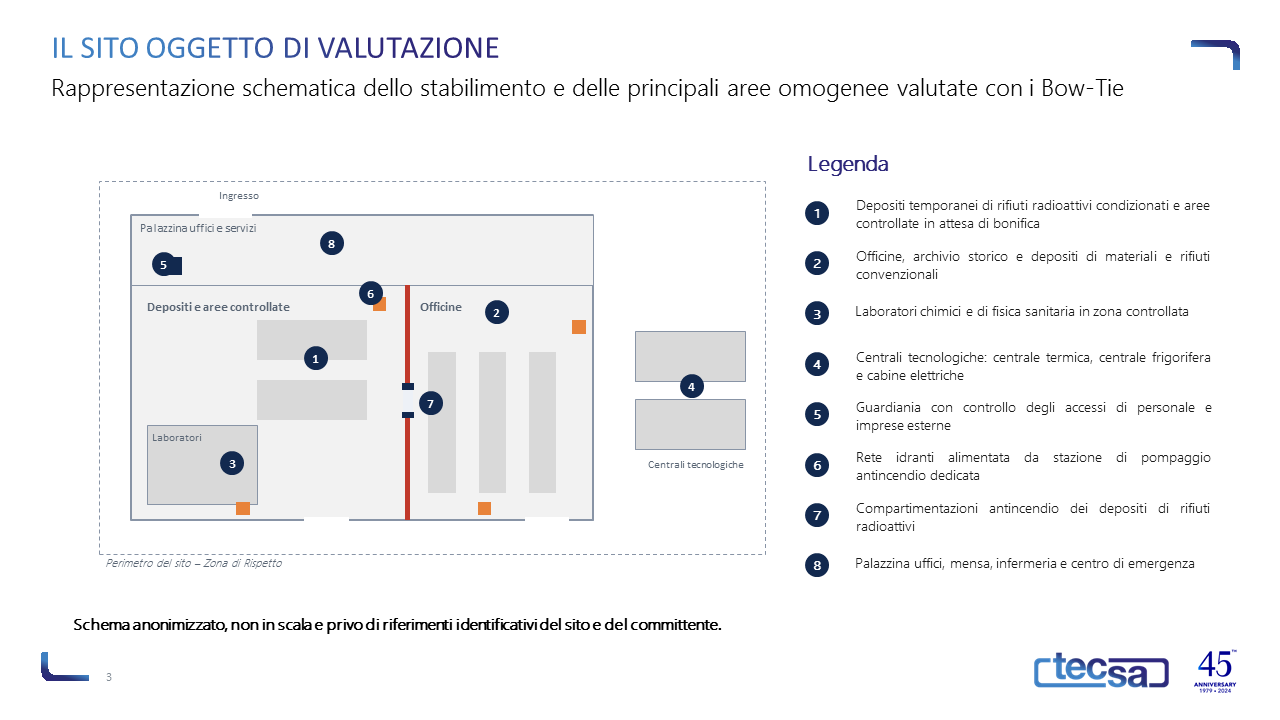
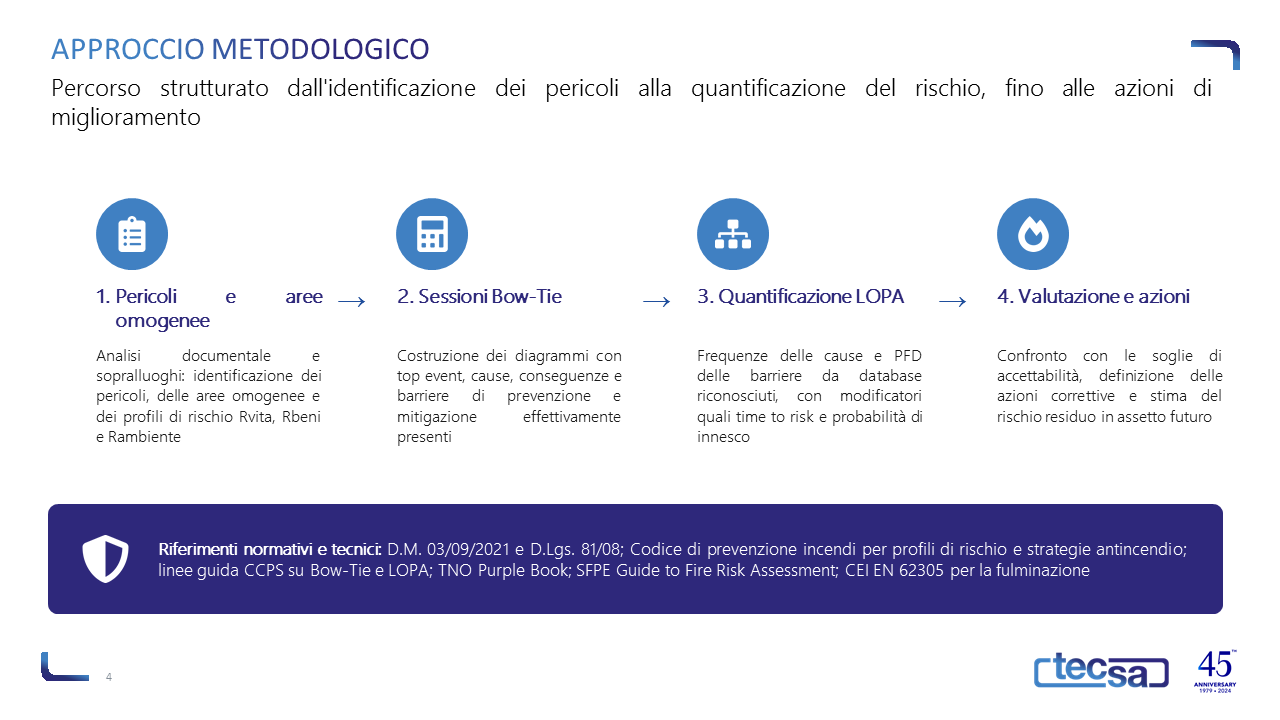
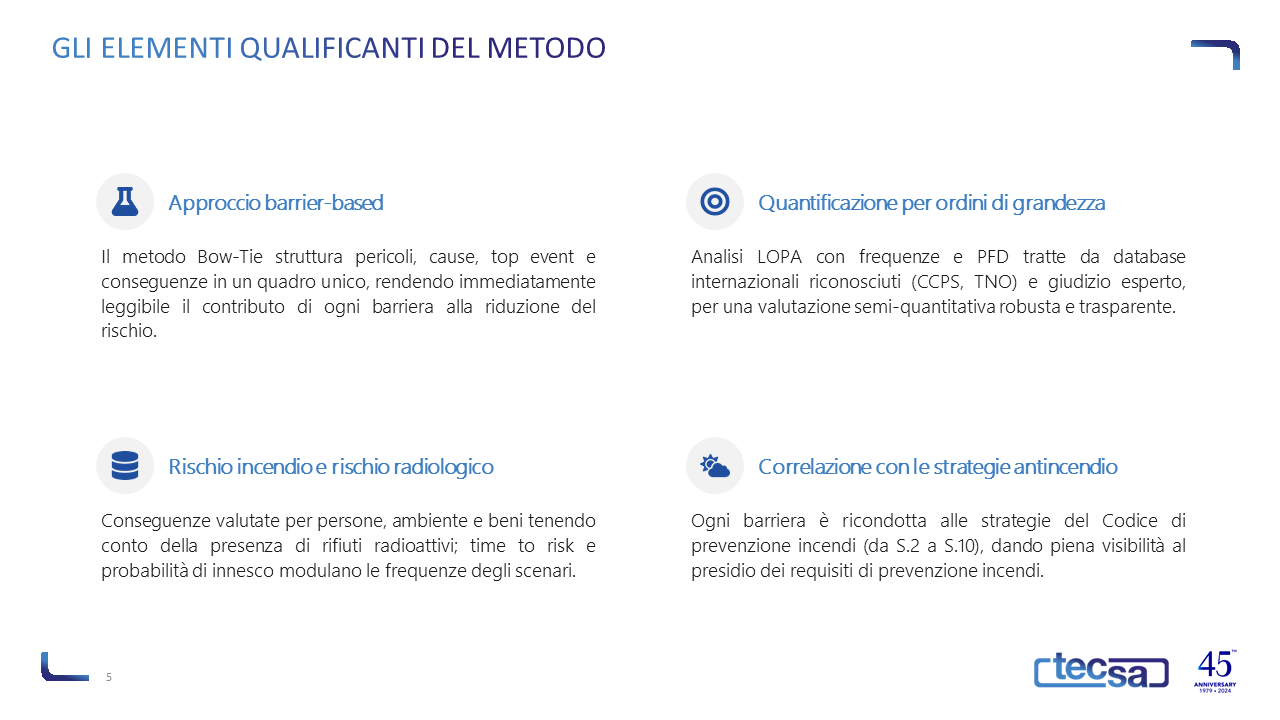
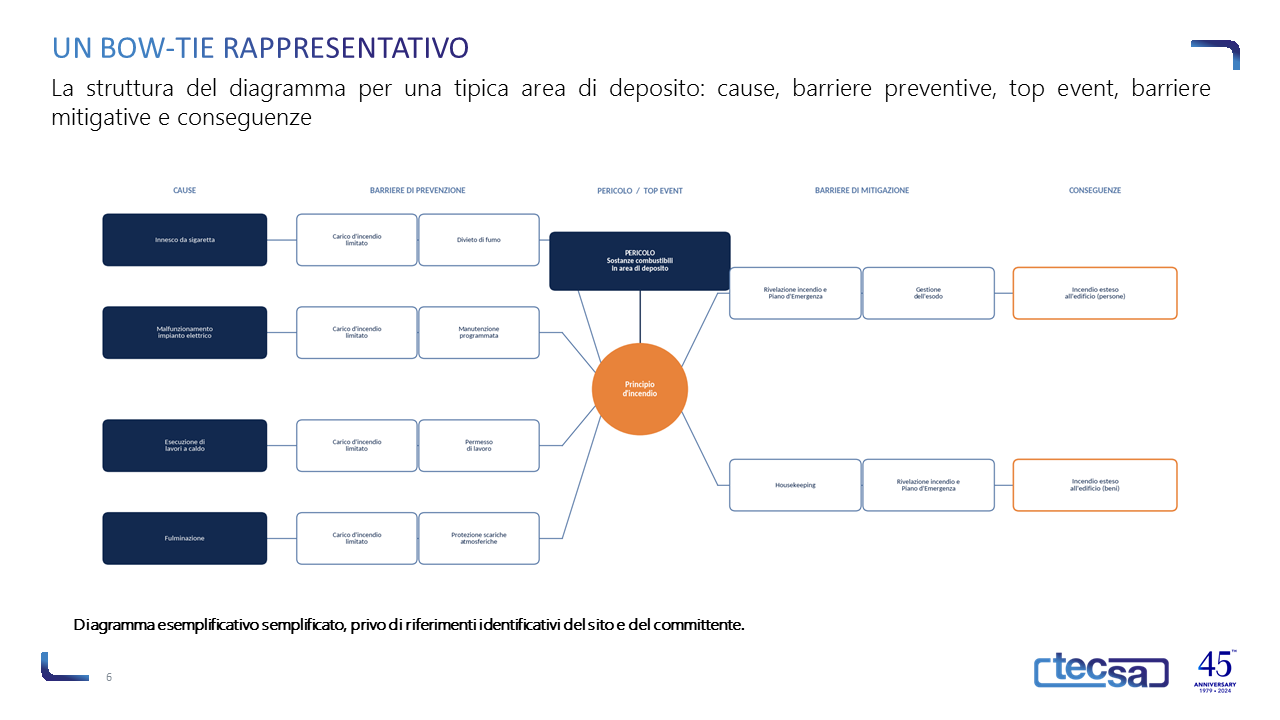
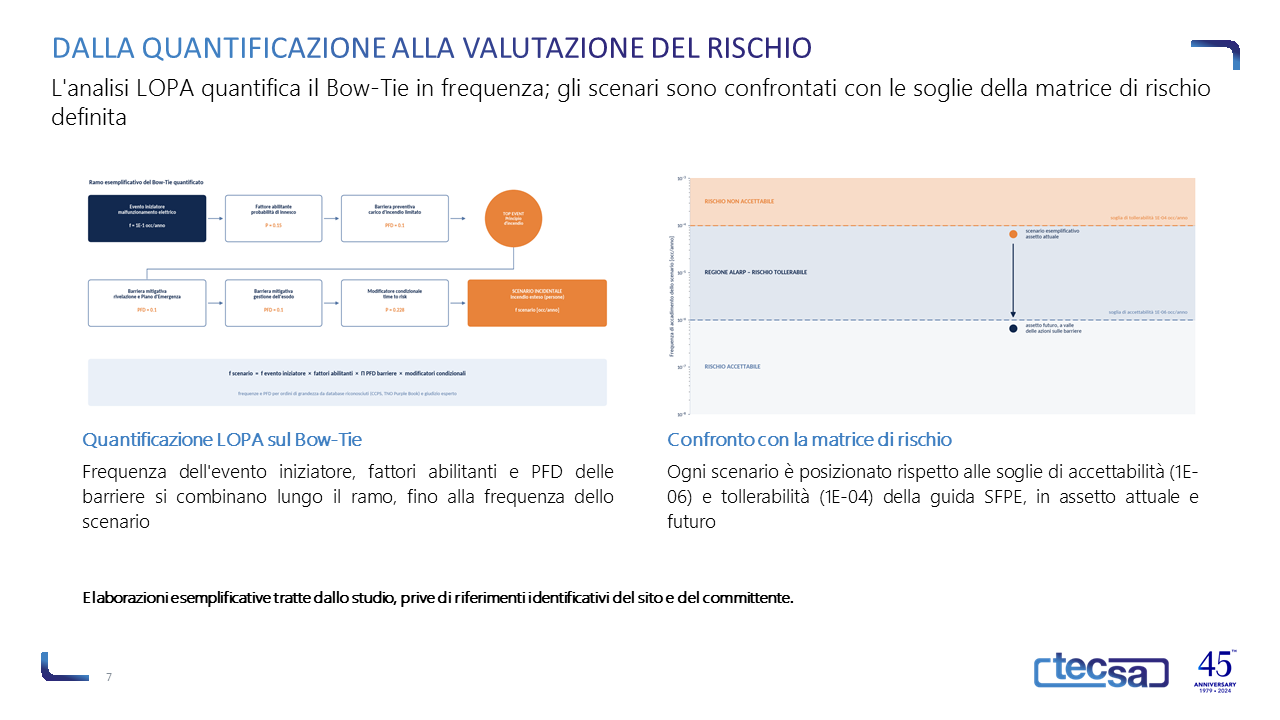
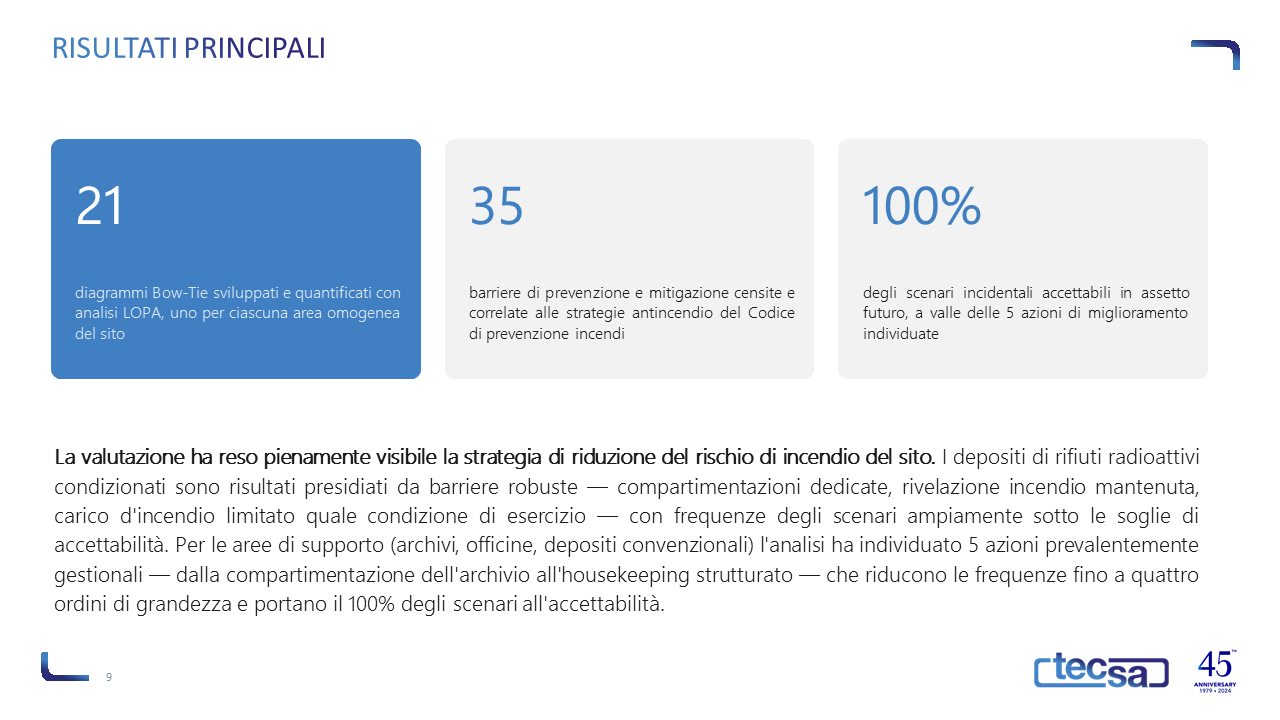
The assessment covered the entire site (approximately 220,000 m²), which is particularly complex and varied in terms of asset types, fire risks and organisational structure: temporary storage facilities for conditioned radioactive waste, former production areas that have been remediated and areas awaiting remediation within the controlled zone, chemical and health physics laboratories, workshops, archives, storage facilities for conventional materials, technical centres, offices and service buildings. For each of the homogeneous areas identified — characterised by the Rvita, Rbeni and Rambiente risk profiles of the Fire Prevention Code — a Bow-Tie diagram was developed, resulting in a total of 21 diagrams constructed on the basis of hazards and the identification of accident scenarios: 21 types of causes, the top fire initiation events, the consequences for people, the environment and property, and 35 prevention and mitigation barriers. The diagrams were quantified using LOPA analysis by orders of magnitude, with frequencies of initiating events and probability of failure on demand (PFD) of the barriers drawn from recognised international databases (CCPS, TNO Purple Book) and adjusted by conditional modifiers and enabling factors (time to risk, probability of ignition), comparing the resulting 28 accident scenarios with the acceptability (1.0E-06 incidents/year) and tolerability (1.0E-04 incidents/year) thresholds set out in the SFPE Guide to Fire Risk Assessment. The correlation of each barrier with the fire safety strategies set out in the Code — from fire resistance to compartmentalisation, from evacuation to fire safety management, from detection and alarm systems to the safety of plant installations — provided a clear overview of the elements constituting the risk reduction strategy in place, in compliance with the requirements of fire prevention regulations.
The analysis provided an immediately comprehensible qualitative and quantitative picture of the site’s inherent safety level: the conditioned radioactive waste storage facilities were found to be protected by robust barriers — dedicated fire compartments, continuous fire detection, and a limited fire load as an operating condition, material encapsulated in a cementitious matrix — with scenario frequencies well below acceptability thresholds, whilst for the support areas, the assessment highlighted, with the same clarity, potential areas for strengthening the risk reduction strategy. This case confirms TECSA’s ability to carry out quantitative fire risk assessments even for sites that are particularly complex and varied in terms of asset type, fire risks and organisation, integrating fire risk and radiological risk into a single, transparent and action-oriented framework.